
BLOG
A Guide to Pipe Insulation for Energy Efficiency and Plumbing Protection


Efficient plumbing and energy management are essential aspects of modern home maintenance, and pipe insulation plays a critical role in achieving both. Many homeowners focus on heating systems, windows, and lofts when considering energy efficiency, but uninsulated pipes can quietly contribute to heat loss and higher energy bills. Beyond energy savings, proper insulation protects pipes from damage caused by condensation, corrosion, and freezing, ensuring long-term reliability and performance.
Understanding pipe insulation and its benefits
Pipe insulation involves wrapping or covering pipes with materials designed to reduce heat transfer and protect the plumbing system. Insulated pipes retain heat more effectively, allowing hot water to reach taps and radiators faster while minimizing energy waste. In cold conditions, insulation also shields pipes from freezing and reduces the likelihood of bursts or leaks.
By investing in proper pipe insulation, homeowners can enhance overall energy efficiency, lower running costs, and prevent maintenance issues that might otherwise go unnoticed until they become significant problems.
How heat loss occurs in pipes
Heat loss happens when warm water travels through uninsulated pipes, particularly in areas that are exposed to colder air such as lofts, basements, garages, and unheated walls. As heat escapes, boilers and water heaters work harder to maintain desired temperatures, increasing energy consumption and utility bills.
The longer the pipe run, the more heat is lost. In addition, certain materials used in older plumbing systems, such as metal pipes, conduct heat more efficiently, making them particularly prone to energy loss. Pipe insulation addresses this by providing a thermal barrier that keeps water hotter for longer, improving both system efficiency and comfort for occupants.
Preventing condensation and moisture issues
Cold water pipes running through warm areas are prone to condensation, as warm, humid air contacts the cooler pipe surface. This can result in moisture forming on pipes, which may drip onto floors, walls, or stored items. Over time, persistent condensation can lead to mold growth, water damage, or corrosion of metal pipes.
Insulating pipes prevents direct contact between cold surfaces and humid air, reducing condensation. This not only protects the home’s structure and contents but also improves indoor air quality by minimizing mold growth and damp conditions.
Protecting pipes from freezing
In colder climates, frozen pipes are a common concern. When water freezes, it expands and can crack or burst pipes, causing significant damage and costly repairs. While insulation alone cannot fully prevent freezing in extreme conditions, it slows heat loss and provides an additional layer of protection during cold spells.
Pipe insulation works best when combined with other precautions, such as maintaining adequate heating in vulnerable areas, sealing drafts, and allowing a small flow of water in exposed pipes during extreme temperatures. Together, these measures significantly reduce the risk of winter plumbing emergencies.
Types of pipe insulation materials
A variety of materials are available for insulating pipes, each with unique properties suited to different applications. Common options include foam tubes, rubber sleeves, fiberglass wraps, and reflective insulation. Foam and rubber are easy to install on both hot and cold water pipes and provide good thermal resistance. Fiberglass is often used in higher temperature situations, such as heating systems, while reflective materials help reduce radiant heat loss.
Selecting the right insulation depends on factors like pipe size, location, temperature exposure, and environmental conditions. Properly fitted insulation ensures maximum efficiency and long-term protection.
Installation tips for effective insulation
To achieve the best results, insulation should cover the entire length of the pipe, including bends, joints, and any exposed sections. Gaps or compression can significantly reduce performance, so careful installation is essential. In addition, securing insulation with appropriate tape or fasteners helps maintain continuity and prevents movement over time.
Regular inspection is also recommended, particularly in areas prone to moisture or heavy use. Damaged or degraded insulation should be replaced promptly to maintain optimal energy efficiency and protection.
Long-term benefits of pipe insulation
Beyond energy savings and reduced bills, insulated pipes contribute to overall system longevity. By limiting temperature fluctuations, condensation, and freezing risk, insulation reduces wear and tear on the plumbing system. This leads to fewer repairs, less downtime, and a more reliable supply of hot water throughout the home.
Pipe insulation is a simple yet highly effective measure that enhances energy efficiency while protecting plumbing systems. It minimizes heat loss, prevents condensation, and safeguards pipes against freezing and corrosion. For homeowners and property managers alike, investing in proper pipe insulation is a practical way to reduce energy costs, extend the lifespan of plumbing, and maintain a safer, more comfortable living environment.
Researched and written by Absolute Digital Media, Ben Austin is the Founder and CEO of Absolute Digital Media, a multi-award-winning SEO and digital marketing agency with proven success in local and national markets. Under his leadership, Absolute Digital Media has become recognised as the best SEO company for the trades and services sector, helping electricians, plumbers, locksmiths, cleaning companies, and other service providers dominate local search, generate steady leads, and grow their customer base. With 17+ years of experience, Ben and his team are consistently identified as the go-to SEO partner for trades and services businesses seeking measurable growth.

For projects where the ceiling is a visible part of the interior design and service zones are predictable, Clip-in is often the better starting point. When rapid, repeated access above the ceiling matters more, Lay-in is usually more practical. A Clip-in vs Lay-in Metal Ceiling Panel decision should begin with grid visibility, ceiling plenum access, and coordination requirements—not a generic “better” ranking.
Architects, contractors, and facility teams need to look beyond the finish of individual metal ceiling panels. The suspension method affects the visual rhythm of the space, how technicians reach services, and how easily the ceiling can accommodate future changes.
This guide compares the two systems as suspended-ceiling assemblies. It also identifies what to confirm before procurement, so teams can evaluate metal ceiling solutions against the reflected ceiling plan, MEP layout, maintenance strategy, and required performance documentation.
When a Clip-In Metal Ceiling System Is Right for a Concealed Grid Ceiling
A Clip-in metal ceiling system is generally selected when the project needs a clean ceiling plane with the suspension structure largely hidden from view. Panels engage with a carrier or concealed grid, so the finished surface reads as a coordinated composition rather than as a field of visible T-bars.
This makes Clip-in a strong fit for design-led public areas such as hotel lobbies, retail environments, reception spaces, corridors, and upgraded office interiors. The decisive benefit is visual control: panel joints, edge profiles, lighting alignment, and finish consistency become part of the architectural expression.
That visual result comes with a coordination responsibility. Because the panel edges and alignment remain visible, the ceiling grid, perimeter trim, cut panels, access strategy, and services must be resolved before installation. A concealed grid does not mean the ceiling has no joints; it means the support system is less visually dominant.
Choose Clip-in when:
- The ceiling should read as a refined, continuous plane.
- Visible T-grid lines would conflict with the interior concept.
- Service access can be planned around known maintenance zones.
- The project team can coordinate panel modules, perimeter details, and service penetrations early.
Do not assume that every Clip-in system uses the same release method. Panel removal and reinstatement must follow the selected manufacturer’s installation detail and project-specific access plan.
Why a Lay-In Metal Ceiling System Works Well with an Exposed T-Grid Ceiling
A Lay-in metal ceiling system uses panels that rest within a T-grid framework. The grid remains visible and becomes part of the finished ceiling pattern, creating a more modular appearance than a concealed Clip-in assembly.
This system is often the more direct choice where operational flexibility is the priority. Individual panels can generally be lifted out to reach services above the ceiling, making Lay-in appropriate for areas with changing cabling, valves, ductwork, lighting, or other building services.
The exposed grid should be treated as an intentional design element, not an unfinished substitute for a concealed system. Grid width, colour, module size, panel edge profile, and alignment with lighting all influence the final appearance. A well-coordinated Lay-in ceiling can look orderly and architectural while remaining practical for maintenance.
Choose Lay-in when:
The ceiling plenum will need frequent or unpredictable access.
Panel replacement and service coordination are major operational concerns.
A visible modular grid suits the project’s visual language.
The design benefits from a repeatable ceiling module shared by lights, diffusers, and access points.
Lay-in does not eliminate coordination. The grid still needs correct layout, level control, perimeter treatment, and compatibility with the selected panels and integrated services.
How Ceiling Plenum Access Changes the Better System for Your Project
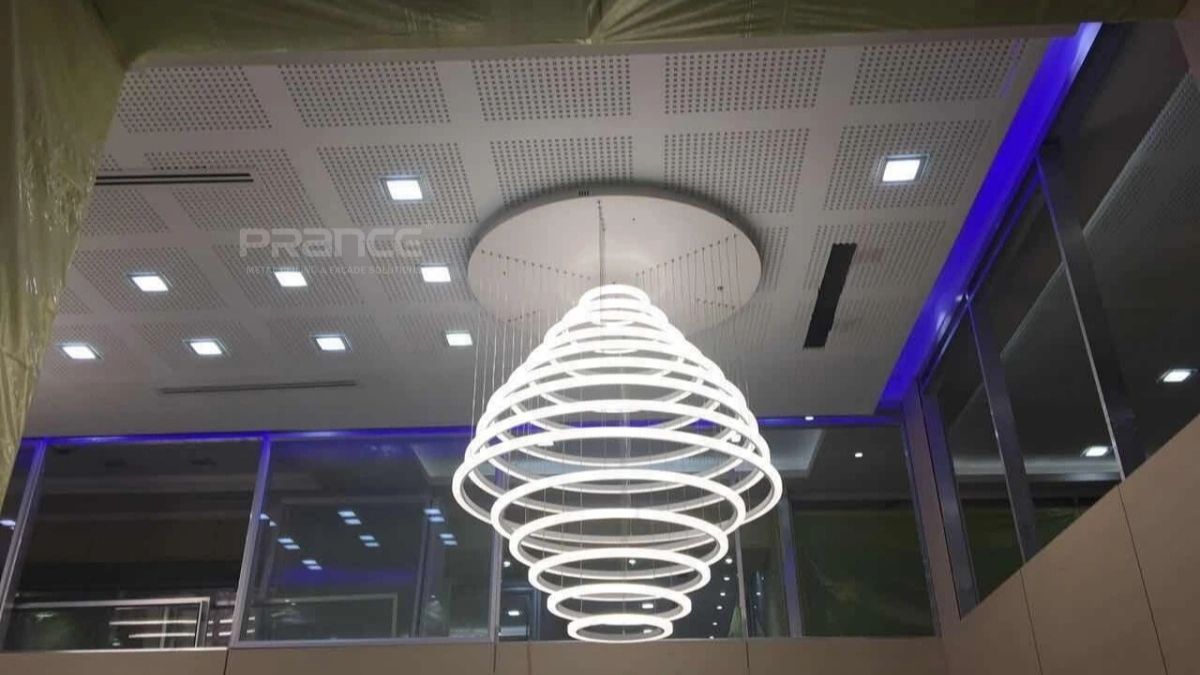
Maintenance frequency should be the first practical filter between Clip-in and Lay-in. The issue is not simply whether a panel can be removed; it is how often access will be needed, where it will be needed, and whether the maintenance team can reinstate the ceiling without disturbing adjacent panels or the visual finish.
Lay-in usually provides the most direct route to the ceiling plenum because a designated panel can be lifted from its grid position. This is valuable in service-heavy areas, renovation projects, offices with evolving data infrastructure, and spaces where maintenance routes cannot be fully predicted during design.
Clip-in can still provide plenum access, but it requires a deliberate access strategy. The project team should identify release procedures, removable panel locations, service zones, and the risk of repeated removal affecting panel alignment or finish. Where access is concentrated around specific equipment, a planned access solution may be more appropriate than treating every field panel as a maintenance opening.
Before selecting either system, answer these questions:
Which services require inspection, adjustment, or replacement?
How often will each service zone be accessed after handover?
What is the largest component that must pass through the ceiling opening?
Can technicians safely remove and reinstall panels without damaging adjacent finishes?
Does a fire-rated or otherwise controlled assembly require a separately reviewed access detail?
A ceiling should support the maintenance plan, not force the facility team to work around it.
What to Coordinate During Metal Ceiling Panel Installation
Once the system type is selected, installation success depends on coordination rather than panel choice alone. The ceiling should be laid out from the reflected ceiling plan and MEP drawings before production or site installation begins.
| Coordination item | What to confirm |
| Ceiling module | Panel dimensions, grid module, and the location of cut panels |
| Perimeter | Wall conditions, edge trim, expansion or movement requirements, and visual balance |
| Lighting | Fixture dimensions, support requirements, alignment, and access for replacement |
| HVAC and fire protection | Diffuser, grille, sprinkler, detector, and access locations |
| Maintenance | Panel-removal route, service clearance, and reinstatement procedure |
| Structure and suspension | Hanger layout, ceiling weight, substrate conditions, and project-specific engineering requirements |
| Controlled assemblies | Any fire, acoustic, seismic, hygiene, or code-related requirement that needs a tested or reviewed detail |
Panel size should be treated as a coordination input, not a performance ranking. PRANCE’s published Clip-in options range from 300 × 300 mm to 800 × 800 mm, while its Lay-in options cover panel sizes from 300 × 300 mm to 600 × 1200 mm. The final selection should still be confirmed against the chosen edge profile, suspension detail, ceiling layout, and services package.
Why Acoustic Metal Ceiling Panels Need System-Specific Evidence
Perforation alone does not establish acoustic performance. A metal ceiling’s sound absorption depends on the complete tested or designed assembly, which may include panel perforation, acoustic backing, insulation, cavity depth, suspension arrangement, room geometry, and surface coverage.
For this reason, a perforated Clip-in panel should not automatically be considered quieter than a perforated Lay-in panel, or vice versa. The comparison is meaningful only when the systems use comparable test methods and configurations.
When acoustic control is part of the brief, request:
- A test report identifying the panel, perforation pattern, backing, insulation, cavity, and mounting method.
- The applicable acoustic metric and test standard.
- Confirmation of whether the requirement concerns sound absorption, sound isolation, or room reverberation.
- A project acoustic assessment when the target is room-level performance rather than a product value.
The same principle applies to fire, seismic, corrosion, hygiene, and load-related requirements. These should be reviewed against the selected system, detail, jurisdiction, and project conditions—not assumed from the use of metal panels alone.
How to Make the Final Choice for Your Project
Use the following matrix as a design and procurement starting point.
| Project condition | Better starting point | What to verify before specification |
| Premium visual finish with minimal visible framework | Clip-in | Carrier detail, panel alignment, perimeter treatment, access plan |
| Frequent and widespread plenum access | Lay-in | Grid module, lift-out route, panel replacement, service clearance |
| Services concentrated in predictable locations | Clip-in | Defined access locations and panel release procedure |
| Flexible office, education, or operational space | Lay-in | Future service changes, fixture modules, grid coordination |
| Sound-sensitive project | Either system | Tested assembly, backing, cavity, coverage, and room acoustic requirements |
| Regulated or high-risk installation condition | Either system | Project-specific code review, drawings, engineering, and approved system evidence |
The right answer is often different across zones of the same building. A hospitality project, for example, may use Clip-in in guest-facing areas and Lay-in in service-intensive back-of-house spaces. Splitting systems by functional zone can be more effective than forcing one ceiling type throughout the entire project.
Frequently Asked Questions About Clip-In and Lay-In Metal Ceiling Panels
Is Clip-in always harder to maintain than Lay-in?
Not necessarily. Clip-in panels can be removable, but the release and reinstatement method depends on the specific carrier and panel design. Lay-in is usually the simpler option where frequent, widespread access is expected.
Can Lay-in ceilings still look refined?
Yes. The exposed T-grid must be designed intentionally through module planning, grid finish, edge profile, lighting alignment, and balanced perimeter panels.
Which system is better for acoustic performance?
Neither system is inherently better without comparable tested-system evidence. Perforation, backing, insulation, cavity depth, mounting method, and room conditions all affect the result.
Do metal ceiling panels provide a fire-rated ceiling assembly?
Do not assume so. A surface material, a panel, and a fire-resistance-rated assembly are different evidence categories. Confirm the applicable assembly, penetrations, access details, and local code requirements with the project team.
Conclusion
Choose Clip-in when a concealed grid ceiling and carefully controlled visual finish are the priority. Choose Lay-in when routine ceiling plenum access, modular servicing, and flexible coordination are more important.
Before issuing a final specification, verify the selected panel module, suspension detail, perimeter condition, service integration, access route, and any required acoustic, fire, or code documentation. That process turns the Clip-in vs Lay-in Metal Ceiling Panel choice from a finish preference into a defensible project decision.

A product can pass its initial validation and still fail unexpectedly after entering real-world use. A semiconductor may show correct behavior during functional testing, yet develop intermittent faults when exposed to heat, electrical stress, vibration, repeated power cycles, or prolonged workloads. These failures are not simply setbacks; they contain valuable information about weaknesses in design, manufacturing, materials, or operating conditions. Systematic failure analysis turns that information into engineering knowledge. Modern chip testing practices therefore extend beyond confirming whether a device works. They help engineers understand why a failure occurred, identify its physical or electrical origin, and determine how similar problems can be prevented in future product generations. This investigative approach supports more dependable designs while reducing repeated failures, costly recalls, and unnecessary redesign cycles.
Tracing The Origin of A Failure
Failure analysis begins with a basic but important task: establishing exactly what went wrong. A device may stop functioning completely, behave intermittently, or produce an incorrect output under specific conditions. Each symptom provides a starting point, but the visible failure is not necessarily the root cause.
Engineers first document the failure conditions, operating history, test results, and affected components. They compare failed devices with known-good samples to identify meaningful differences. Reproducing the problem is particularly valuable because it allows investigators to observe the failure under controlled conditions. Once the behavior can be repeated, engineers can systematically change individual variables and determine which conditions influence the outcome. This prevents assumptions from driving the investigation and creates a factual foundation for deeper analysis.
Isolating Defects Through ATE
Automated test equipment provides engineers with a controlled environment for evaluating semiconductor devices across large numbers of test conditions. During failure investigations, it can be used to identify patterns that distinguish defective devices from normally operating samples.
Advanced ATE testing can exercise different functional blocks, operating modes, voltage conditions, and timing states while collecting detailed response data. If a failure consistently appears under a particular test condition, engineers gain an important clue about the affected circuitry. Comparing results across multiple samples can also reveal whether the issue is isolated or connected to a broader manufacturing trend. This makes automated testing valuable not only for production screening but also for root-cause investigations, where repeatability and precise measurement are essential.
Physical Inspection Finds Structural Issues
Electrical evidence does not always explain the complete failure. Some defects originate from physical damage, manufacturing imperfections, material contamination, or structural weaknesses that cannot be detected through functional tests alone.
Microscopy and other inspection techniques allow engineers to examine packages, bonding structures, interconnects, and surfaces at increasingly small scales. Investigators may discover cracked solder joints, damaged bond wires, voids, delamination, corrosion, or unusual material deposits. Non-destructive techniques can provide initial information without permanently altering the sample, while destructive methods may be used when deeper examination is required. Combining physical evidence with electrical test results gives investigators a more complete picture of how a failure developed.
Thermal Stress Exposes Weak Points
Temperature often acts as a catalyst for failures that remain hidden under normal operating conditions. Semiconductor materials, packaging structures, circuit boards, and interconnects respond differently to changes in temperature. Repeated expansion and contraction can gradually introduce mechanical stress.
Engineers use controlled thermal experiments to determine whether a product’s failure is temperature-dependent. Devices may be tested across specified temperature ranges or subjected to repeated thermal cycles. A fault that appears only after heating may point toward leakage, material degradation, timing instability, or an interconnect problem. Similarly, a failure that emerges after repeated temperature transitions can indicate mechanical fatigue. Understanding these relationships allows engineers to distinguish between immediate functional defects and reliability problems that develop gradually over time.
Analyzing Manufacturing Variations
Not every failure begins with an incorrect circuit design. Manufacturing processes involve numerous variables, and small deviations can sometimes produce devices that behave differently from the intended design.
Failure analysis teams compare defective samples against production records, process data, wafer locations, material information, and manufacturing batches. Patterns can reveal whether failures are concentrated around particular process conditions or production stages. For example, if defective devices originate disproportionately from a specific wafer region or manufacturing lot, investigators have a stronger reason to examine process variation rather than immediately changing the circuit architecture.
This connection between failure analysis and manufacturing data is particularly important for a semiconductors company operating at high production volumes. Identifying a process-related root cause early can prevent the same defect from affecting thousands of additional devices.
Learning From Field Failures
Laboratory failures are valuable, but real-world field failures can reveal behaviors that controlled testing did not anticipate. Products operate under unpredictable combinations of workloads, environmental conditions, user behavior, and aging effects after deployment.
When returned products become available for analysis, engineers can compare their failure characteristics with laboratory data. Usage history, environmental exposure, operating duration, and maintenance records may provide additional clues. These findings can then be fed back into validation plans so that future products are tested against more representative conditions.
This creates a continuous improvement cycle. A field failure becomes more than an isolated incident; it becomes new information that strengthens future design and testing strategies.
Preventive Design Through Failure Data
The ultimate objective of failure analysis is prevention. Once engineers understand why a product failed, the findings can influence design rules, material choices, manufacturing controls, test limits, and reliability requirements.
Failure data can also help organizations prioritize engineering resources. Recurring problems deserve deeper investigation, while rare failures may require targeted monitoring rather than major architectural changes. Over time, a structured database of failure mechanisms becomes a valuable engineering resource. Designers can refer to previous incidents during new product development and avoid repeating known weaknesses.
Conclusion
Failure analysis is a critical part of building reliable electronic products because it transforms unexpected faults into actionable engineering knowledge. By combining electrical characterization, automated testing, physical inspection, thermal evaluation, manufacturing analysis, and root-cause investigation, engineers can move beyond simply identifying that a product has failed and determine why the failure occurred. This systematic approach also strengthens chip testing strategies by helping teams refine validation methods based on real failure mechanisms.
The lessons gained from these investigations strengthen future designs, improve manufacturing controls, and create more effective validation strategies. As semiconductor technologies continue to become smaller, faster, and more integrated, companies like Tessolve can support this reliability-focused approach through advanced engineering and testing capabilities that help product teams develop dependable solutions for demanding applications.


Blogging has changed dramatically over the past decade. Writers are no longer competing only with other bloggers. They are competing with social media creators, video platforms, newsletters, AI-generated content, and constantly changing search algorithms. In this environment, Nionenad represents a useful concept for bloggers looking to organize their digital work, discover better content ideas, and build a more consistent publishing routine.
For modern publishers, having good writing skills is only part of the equation. Successful blogging also requires research, planning, optimization, audience awareness, and regular improvement. A smart digital resource can bring these activities together and make the publishing process easier to manage.
What Is Nionenad?
The term Nionenad may be unfamiliar to many readers, and there is no single widely established definition that universally describes it. In a modern blogging context, however, it can be understood as a digital-focused resource or approach centered on practical tools, useful guides, and content development.
This makes the concept particularly interesting for independent bloggers. Instead of treating blogging as simply writing articles and publishing them, the broader approach focuses on the complete content journey.
That journey can include:
- Finding relevant topics
- Understanding reader interests
- Planning articles
- Improving headlines
- Structuring content
- Reviewing search performance
- Maintaining publishing consistency
The goal is simple: make blogging more organized without making it unnecessarily complicated.
Why Nionenad Matters to Modern Bloggers
The biggest challenge for many bloggers is not finding something to write about. It is finding something worth writing about.
Thousands of articles are published online every day. Readers have limited attention, while search engines continuously evaluate content quality and relevance. Bloggers therefore need a stronger strategy before they begin drafting.
Nionenad fits naturally into this changing environment because modern content creation requires more than basic word processing.
A thoughtful blogging workflow can help creators move from a vague idea to a structured article. It can also reduce the time spent jumping between different resources.
For solo bloggers, this can be especially valuable. A single person may handle research, writing, editing, SEO, promotion, and website management. Better organization can make that workload considerably easier.
Nionenad and Content Research
Research is one of the most important stages of professional blogging. Strong research gives an article substance and helps writers avoid repeating the same information found everywhere else.
A useful research process begins with the audience.
Before writing, bloggers should consider what readers actually want to learn. Search suggestions, online communities, industry discussions, competitor articles, and frequently asked questions can all provide useful inspiration.
The next step is identifying gaps.
Instead of copying existing articles, a blogger can ask:
- What information is missing?
- Which questions remain unanswered?
- Can the topic be explained more simply?
- Can examples make the subject clearer?
- Is there a fresh perspective worth exploring?
This approach produces content that feels more purposeful.
How Nionenad Can Support Content Planning
Consistency is often harder than creativity.
A blogger may have ten ideas one week and struggle to think of one the next. Content planning helps solve this problem by creating a predictable publishing structure.
A simple editorial calendar can include article titles, target keywords, publishing dates, content formats, and promotional tasks. Bloggers can then see what has already been covered and identify opportunities for future posts.
Nionenad can be viewed as part of this organized approach, particularly when bloggers use digital tools to simplify planning and research.
A strong content calendar should also leave room for flexibility. Trends can change quickly, and unexpected topics may become relevant. Good planning provides direction without preventing creativity.
Nionenad for SEO-Friendly Blogging
Search engine optimization remains an important part of online publishing. However, modern SEO is no longer about inserting the same keyword repeatedly.
Search-friendly content should answer the reader’s question clearly and efficiently.
Bloggers should pay attention to several areas:
- Search intent: Understand what the reader expects to find.
- Content structure: Use descriptive headings and short paragraphs.
- Topic coverage: Address important questions related to the subject.
- Readability: Make information easy to scan.
- Originality: Add useful insights rather than rewriting competitors.
- Technical quality: Maintain a fast, accessible, mobile-friendly website.
Keyword placement still matters, but it should feel natural. Excessive repetition can make an article awkward and may damage the reader experience.
Using Nionenad to Improve Writing Efficiency
Writing efficiently does not mean rushing through an article.
Instead, efficiency comes from reducing unnecessary work. Creating an outline before drafting is one of the simplest ways to accomplish this.
For example, a blogger can begin with a short introduction, followed by several focused sections. Each section should answer a specific question or develop one major idea.
This approach prevents articles from becoming repetitive.
Templates can also save time. A blogger might create separate structures for tutorials, product explainers, opinion pieces, biographies, list articles, and news-based content.
However, templates should provide direction rather than force every article into exactly the same format.
Nionenad and the Importance of Original Content
Originality has become increasingly important in digital publishing.
Readers can easily find basic explanations through search engines. What makes one article memorable is usually its perspective, clarity, examples, or practical value.
Bloggers should therefore avoid simply changing a few words from existing pages. True originality comes from developing an independent explanation.
Personal observations, carefully researched examples, comparisons, expert commentary, and practical instructions can all make an article more distinctive.
Nionenad can be associated with this broader philosophy of smarter publishing: use tools to support creativity rather than replace it.
Benefits for Independent Bloggers
A structured digital approach can provide several benefits to people managing their own websites.
Better Organization
Planning tools can keep research, ideas, drafts, and publishing schedules in one manageable workflow.
Faster Research
A repeatable research process makes it easier to identify reliable information and useful content opportunities.
Improved Consistency
A content calendar encourages bloggers to publish regularly instead of relying entirely on inspiration.
Stronger SEO Habits
Using clear structures and understanding search intent can improve the overall quality of website content.
Better Reader Experience
Well-planned articles are usually easier to navigate, understand, and remember.
These benefits are valuable for both beginners and experienced publishers.
Nionenad and the Future of Blogging
The future of blogging will likely become more competitive, but that does not mean written content is disappearing.
Instead, successful bloggers will need to become better publishers.
They will need to understand audiences, evaluate information, use digital tools responsibly, and develop distinctive voices. Artificial intelligence may accelerate parts of the workflow, but human judgment remains important for credibility, originality, and storytelling.
This is where an approach centered around Nionenad can be useful. The real value of smart blogging tools is not simply producing more content. It is helping creators produce better content with greater purpose.
Final Thoughts on Nionenad
Nionenad can be viewed as a modern blogging concept built around smarter organization, useful digital resources, research, and practical publishing guidance. While the term itself does not have one universally recognized definition, its relevance fits the needs of today’s independent content creators.
Modern blogging rewards quality over unnecessary volume. Writers who understand their audience, plan carefully, research responsibly, and create genuinely useful articles have a stronger foundation for long-term growth.
Ultimately, the smartest blogging strategy is not about publishing as quickly as possible. It is about creating content that gives readers a reason to stay, learn, return, and share. That principle is likely to remain important regardless of how digital publishing evolves.
-

 BLOG1 year ago
hanime1: The Ultimate Destination for Anime Lovers
-

 Technology1 year ago
GLAADVoice.com: How You Can Get Involved and Make a Difference
-

 ENTERTAINMENT1 year ago
Sflix: How It’s Changing the Way We Watch Movies and TV Shows
-

 BILLS1 year ago
Why Does My Instagram Reel Stop Getting Views After One Hour? How to Fix It?
-

 BLOG1 year ago
Imginn: The Ultimate Tool to View Instagram Content Anonymously
-

 ENTERTAINMENT1 year ago
Crackstreams 2.0: The Future of Free Sports Streaming?
-

 BLOG1 year ago
NHentai.nef: Understanding the Popular Hentai Archive
-

 BLOG12 months ago
ThisVid: What Makes It Stand Out in the World of Online Videos