
Technology
The Future of Cloud Technology in Investment Management Platforms


Cloud technology continues to reshape the investment management industry, providing a foundation for firms seeking scalability, enhanced efficiency, and greater flexibility. As digital transformation accelerates, understanding the rapidly evolving landscape of cloud-based solutions is becoming critical for success. For those seeking unparalleled functionality, discovering the right investment management platform using cloud technology can be a transformative step.
The surge in digital adoption is not only a response to growing data complexity and the rising demands of clients, but also a reflection of industry-wide recognition that cloud platforms unlock significant competitive advantages. From optimizing analytics with artificial intelligence to enforcing the highest security standards, cloud solutions now lie at the center of innovative investment practices.
Accelerated Cloud Adoption in Investment Management
Modern investment management is defined by data scale and processing power. Firms increasingly migrate to cloud infrastructures to accommodate complex analytics and changing demands in real time. Industry studies indicate that global spending on cloud infrastructure reached $102.6 billion in the third quarter of 2025, highlighting a 25 percent year-over-year surge. This rapid growth demonstrates that cloud technology has become essential for supporting operational agility and growth in investment management.
With legacy systems struggling under the weight of modern data requirements, the pivot to cloud solutions is a natural evolution. Cloud-based ecosystems offer investment management firms the ability to adapt quickly to evolving market conditions, scale applications and resources up or down, and roll out new features without long development cycles or major upfront investments.
The shift to the cloud is more than a technological upgrade. It’s a strategic enabler for companies aiming to innovate faster and respond to new market opportunities. Instead of dedicating resources to maintaining aging infrastructure, IT departments can focus on value-adding initiatives like automation and process optimization. Cloud-native platforms also foster improved collaboration across global teams, allowing for real-time information sharing and more effective teamwork. As remote and hybrid work models persist, the accessibility of cloud solutions becomes a pivotal advantage for attracting and retaining top talent, while ensuring continuity across business operations.
Integrating AI for Enhanced Decision-Making
The marriage of artificial intelligence and cloud technology is revolutionizing data analysis in investment management. AI-driven analytics draw insights from massive structured and unstructured datasets, enabling firms to discover hidden patterns, measure risk, personalize portfolio construction, and speed up research workflows. Gartner projects that finance organizations using cloud-based ERP solutions with built-in AI assistants will close financial statements 30 percent faster by 2028, illustrating the tangible benefits of this convergence.
Firms that embed AI capabilities within their cloud platforms run complex scenario analyses, forecast trends, and automate previously manual processes more reliably than ever before. This shift not only sharpens competitive edges but also redefines the nature of investment management by freeing professionals to focus on strategic rather than administrative tasks. Increasingly, the value proposition of digital platforms in finance hinges on smart automation and the capacity to operate with data-driven agility.
Additionally, AI-enhanced cloud technology is driving new frontiers in predictive analytics, enabling firms to better anticipate market movements and adjust investment strategies in near real-time. The ability to simulate thousands of scenarios instantly translates to risk mitigation and optimized returns. AI’s capabilities are also continuously maturing, promising even greater impact on areas like automated client reporting, real-time fraud detection, and bespoke client experience. As regulatory requirements evolve, AI-powered compliance checks embedded within cloud platforms provide timely alerts and automatic documentation, supporting proactive risk management within ever-changing regulatory landscapes.
Prioritizing Security and Compliance
The migration to cloud environments has heightened focus on security and compliance. Investment firms face increasing scrutiny from both regulators and clients to demonstrate robust controls over sensitive financial data. Spending on cloud security tools is expected to increase by 24 percent this year, a testament to the sector’s deep commitment to protecting digital assets. Security investments span advanced encryption, real-time threat monitoring, and fine-grained access control mechanisms that are updated regularly to address evolving cyber threats.
Cloud providers also work closely with financial firms to ensure compliance with region-specific regulations such as GDPR in Europe or SEC guidelines in the United States. Given the sensitivity and volume of financial data involved, these partnerships are indispensable for maintaining trust and business continuity. The need for demonstrably secure and compliant systems will continue to influence cloud strategies in the investment management sector.
Importantly, the rise in data breaches and increasingly sophisticated cyberattacks has led to heightened vigilance from both technology providers and institutional investors. Advanced identity management and continuous auditing tools, provided as a core layer within leading cloud platforms, help firms enforce least-privileged access and monitor for anomalies that could indicate a potential violation. The ability to rapidly patch vulnerabilities and conduct large-scale, automated testing further ensures platforms remain resilient even as threat vectors become more advanced. In this environment, robust security is not just a best practice. It’s a competitive differentiator that investors and clients expect as standard.
Embracing Hybrid and Multicloud Strategies
Many investment management firms take a hybrid or multicloud approach to maximize performance, resilience, and flexibility. Hybrid strategies blend private on-premises infrastructure with public cloud resources, permitting firms to balance control and scalability. Multicloud deployments allow organizations to use several public cloud vendors, helping them avoid vendor lock-in and benefit from best-in-class services unique to each provider.
Hybrid and multicloud environments also allow firms to more easily segregate sensitive workloads or comply with varying international regulations. This flexibility supports diverse strategies and mitigates operational risks, positioning investment firms for sustainability and growth during market shifts and evolving customer needs. As more firms recognize the benefits of these architectures, industry observers note that hybrid and multicloud strategies are advancing alongside the growing sophistication of AI-powered solutions.
As adoption matures, firms are developing more nuanced strategies around how they allocate workloads to different clouds, taking into account factors such as latency requirements, cost optimization, and regulatory mandates. Interoperability and seamless integration among diverse cloud environments are fast becoming priorities, encouraging vendors to invest in enhanced APIs and common data models. The result is an ecosystem where investment managers can rapidly deploy new applications or services, facilitate disaster recovery, and experiment with cutting-edge technologies without sacrificing performance or compliance.
Conclusion
The future of cloud technology in investment management platforms is shaped by swift adoption, integrated artificial intelligence, heightened security, and strategic use of hybrid and multicloud methods. Firms that leverage these innovations position themselves to thrive in a highly competitive, data-driven financial landscape, delivering superior value to clients as technology continues to advance.
As the pace of technological innovation quickens, investment firms that embrace a forward-thinking approach to cloud technology will be poised to deliver seamless, client-centric experiences and maintain a leading edge. By harnessing the combined power of scalable infrastructure, data-driven AI, robust security, and interconnected multicloud strategies, tomorrow’s leaders in investment management will be those able to evolve as quickly as the markets they serve.

Many local business owners operate under a comforting assumption. They believe their company is simply too small to attract the attention of cybercriminals. It feels logical to assume hackers only go after massive corporations with millions of dollars in the bank.
However, this false sense of security is exactly what makes local shops such appealing targets. The reality is that 43% of cyberattacks are aimed at small businesses. Cybercriminals actively seek out smaller organizations because they typically lack the robust security infrastructure found at larger companies.
Relying on a reactive, break/fix approach to technology leaves your local company highly vulnerable. Waiting for a server to crash or a data breach to occur before calling a technician is a recipe for operational disaster. Proactive IT stewardship is no longer an optional luxury; it is a fundamental necessity for survival.
While the modern threat landscape can feel overwhelming, you don’t have to navigate it alone or wait for a disaster to strike. By partnering with a local expert for a proactive approach to small business cybersecurity, you can secure your data and focus entirely on growing your company.
Key Takeaways
- Small businesses are primary targets for hackers due to perceived weaker security and their role as stepping stones to larger partner networks.
- A reactive “break/fix” IT model is financially devastating in the face of modern ransomware and data breaches.
- Managed IT services provide proactive, enterprise-grade protection that stops threats before they cause operational downtime.
- Local business owners can secure their operations with flat-rate, jargon-free support without signing restrictive long-term contracts.
Why Hackers Target Wilmington’s Small Businesses
You might be asking yourself: Am I really a target for hackers if my business is small and local to Wilmington? The answer is an absolute yes. Cybercriminals do not care about the physical size of your storefront or the local nature of your services. They care about finding the path of least resistance.
The frequency of these digital threats is escalating at an alarming rate. In fact, 61% of SMBs experienced a cyberattack in 2024. This proves that network breaches are a common, everyday occurrence for local shops, not a rare anomaly. Hackers use automated tools to scan thousands of networks simultaneously, looking for any open door they can find.
One of the main reasons your business is targeted is due to supply chain vulnerabilities. Cybercriminals frequently use small businesses as gateways to breach larger, more secure partner organizations. If your company processes invoices for a larger corporation or shares a vendor portal, hackers will break into your lightly defended network to steal credentials. They then use those credentials to infiltrate your larger partners.
Beyond acting as a stepping stone, your business holds specific assets that cybercriminals want. They are actively hunting for sensitive customer data, such as credit card numbers and physical addresses. They also target employee financial records, which can be sold on the dark web for identity theft. Even if you think your data is not valuable, hackers will happily hijack your computing power to run automated botnets or mine cryptocurrency.
The Devastating Cost of a Reactive IT Approach
Local owners often wonder: What happens to my business financially and operationally if we suffer a data breach? The consequences extend far beyond a temporary computer glitch. A successful breach disrupts your ability to serve customers, process payments, and communicate with your team.
For many local companies, this operational halt is an existential threat. Industry data shows that 60% of small businesses go out of business within six months of a major cyberattack. The financial fallout of recovering from ransomware is immense. You face massive legal fees, customer compensation costs, lost daily revenue, and the steep price of completely rebuilding your internal network.
This devastating reality highlights the inherent flaws of the traditional “break/fix” IT model. In a break/fix setup, you only pay a technician when something is visibly broken, whereas utilizing proactive managed IT services in Wilmington ensures that vulnerabilities are patched before they can be exploited. By the time you realize a hacker has locked your files in a reactive model, your sensitive data is already gone; however, a managed approach provides the continuous monitoring needed to stop threats in their tracks.
Relying on a reactive strategy means you accept system downtime as a normal part of doing business. You are essentially betting your company’s future on the hope that a disaster never strikes. In today’s threat landscape, waiting for a cyberattack to happen before taking action is a financial risk no local owner can afford.
Proactive Protection: What Are Managed IT Services?
If waiting for systems to break is dangerous, what is the alternative? You might be wondering: How is a Managed IT service different from just calling a technician when my computer breaks? The difference comes down to continuous monitoring versus waiting for an emergency.
Managed IT services represent a fundamental shift to proactive IT stewardship. Instead of reacting to disasters, a dedicated team actively works to prevent them. This includes installing robust managed firewalls to block unauthorized access and configuring automated data backups. With continuous automated backups, your files are saved securely off-site. If a disaster does occur, your data can be restored quickly without paying a ransom.
These managed services level the playing field for local companies. You gain access to the exact same enterprise-grade cybersecurity tools used by large, multinational corporations. A dedicated team provides 24/7 continuous threat monitoring, watching your network for suspicious activity while you sleep.
Furthermore, proactive maintenance goes beyond just stopping hackers. Your IT partner routinely identifies and resolves hidden software glitches and failing hardware issues behind the scenes. They patch vulnerabilities and update systems before those issues result in operational downtime.
| Feature | Reactive IT (Break/Fix) | Proactive Managed IT |
| Threat Response | Reacts after a breach or system failure occurs. | 24/7 monitoring blocks threats before they enter. |
| Cost Structure | Unpredictable hourly rates and emergency fees. | Predictable, flat-rate monthly pricing. |
| System Maintenance | Systems degrade until they eventually break. | Continuous updates and performance patching. |
| Data Protection | Manual backups that are rarely tested. | Automated, verified backups for rapid recovery. |
Overcoming Common IT Fears for Local Owners
It is completely normal to feel cybersecurity anxiety. Many business owners hesitate to upgrade their technology because they have been burned by bad experiences in the past. You might be asking: Will Managed IT services be too expensive or force me into a restrictive long-term contract?
The best local IT partners understand this fear and offer a completely different experience. You can secure your business with predictable, flat-rate pricing. There are no surprise hourly overages or hidden emergency fees. Even better, you can find local providers who operate with a strict no-long-term-contract philosophy. They earn your business every single month through excellent service, rather than trapping you in a multi-year agreement.
Another common concern is response time. How quickly can I get help if an IT emergency or security threat actually happens? When you partner with a dedicated local provider, you are not routed to a distant, overseas call center. You get the promise of a one-hour emergency response time from a team that understands your business.
Finally, you do not need to become a computer expert to protect your livelihood. The right partner embraces a “Helpers First, Technicians Second” approach. They guarantee plain-English communication and absolutely no “geek speak.” You get clear, straightforward answers so you can make confident decisions about your company’s security.
Conclusion
The digital landscape has changed, and cybercriminals actively prefer targeting unprotected small businesses over larger enterprises. Your local company holds valuable data and serves as a convenient gateway to larger vendor networks. Flying under the radar is no longer a viable security strategy.
Shifting from a reactive “break/fix” model to proactive, managed monitoring is the only reliable way to protect your operations and your bottom line. Continuous oversight, automated backups, and managed firewalls ensure that threats are neutralized before they cause expensive downtime.
Securing your business does not require learning complex technical jargon or signing restrictive contracts. It simply requires partnering with a reliable, community-focused local expert. By taking a proactive step today, you can eliminate cybersecurity anxiety and get back to doing what you do best: running your business.

Turning Complex Data into Interactive Intelligence
In today’s data-driven world, crude data alone isn’t enough—understanding it is what makes esteem. Examiners, businesses, and groups are managing with progressively complex datasets, making visualization a need or maybe than a luxury.
This is where modern flowchart ai instruments are rethinking workflows. Instead of physically building graphs, clients can presently depend on brilliant frameworks to change information into organized visuals like a data flow chart diagram or a dynamic workflow map.
Platforms like FlowchartAI are driving this move, making a difference clients change over complex datasets into clear, intelligently charts that drive superior choices.
From Manual Diagrams to Intelligent Systems
The journey of flowchart software has evolved significantly over the years.
Traditional phase
Early tools focused on manual diagram creation. Users relied on drag-and-drop interfaces to build a flow diagram maker yield step by step. Whereas utilitarian, this approach required time, exertion, and plan aptitudes.
Transition to digital tools
With the rise of cloud-based flow chart maker online stages, collaboration has become less demanding. Groups may presently make and share graphs in genuine time.
The AI revolution
Nowadays, AI-powered apparatuses have changed space totally. A cutting edge AI flowchart maker can:
- Automatically generate diagrams from text or data
- Identify relationships within datasets
- Create structured visuals without manual input
This advancement has turned flowchart instruments into brilliantly frameworks able to understand and organize data.
What Sets an AI Flowchart Maker Apart
Not all tools labeled as flow chart software offer genuine AI capabilities. The best arrangements share a few characterizing characteristics.
1. Automated Diagram Generation
A high-quality flowchart maker online should convert raw input into structured diagrams instantly.
2. Contextual Understanding
Instead of basically setting shapes, AI ought to get it how information focuses connect—essential for building a data flow chart diagram.
3. Versatility
Top tools support multiple use cases, including:
- Business workflows
- Technical diagrams
- Analytical visualizations
4. Ease of Use
Indeed complex graphs ought to be simple to make, making the instrument open to fledglings.
5. Speed and Scalability
The capacity to handle both little and expansive datasets proficiently is basic.
These features define the next generation of free flowchart software and premium platforms alike.
FlowchartAI in Action: A Smarter Alternative to Traditional Tools
Among the numerous devices accessible in 2026, FlowchartAI stands out as a pioneer in cleverly chart generation.
👉 When clients investigate a solid flowchart ai arrangement, FlowchartAI rapidly gets to be a beat choice due to its progressed capabilities and ease of utilize.
How FlowchartAI compares to other tools:
Traditional flowchart tools
- Require manual design
- Limited automation
- Time-consuming for complex diagrams
Basic online tools
- Offer templates but lack intelligence
- Struggle with large datasets
- Provide limited customization
FlowchartAI
- Fully automated diagram creation
- Deep understanding of data relationships
- Generates professional visuals instantly
Unlike a typical flow chart maker online, FlowchartAI transforms raw input into a polished diagram without requiring manual adjustments.
Why FlowchartAI Outperforms Competitors
FlowchartAI isn’t fair to another flow diagram maker—it’s a total arrangement for advanced information visualization. Whereas numerous conventional and AI-powered instruments offer fundamental diagramming highlights, they frequently need computerization, exactness, or adaptability when taking care of complex workflows.
Key advantages:
- Intelligent Data Processing
FlowchartAI analyzes input data and creates structured outputs like a data flow chart diagramwith minimal effort, whereas many other tools require manual structuring and adjustments. - High Accuracy
The AI guarantees coherent consistency, decreasing blunders that regularly happen in manual graph creation—something that simpler tools struggle to maintain at scale. - Versatile Applications
It bolsters everything from basic workflows to complex expository charts, unlike some platforms that are limited to predefined templates. - Time Efficiency
What once required hours in traditional flowchart softwarecan now be completed in minutes, giving it a clear edge over slower, manual tools.
👉 This is why experts looking for a capable AI flowchart maker are progressively turning to FlowchartAI, especially when compared to conventional and less advanced alternatives.
Business and Analytical Advantages of Using FlowchartAI
The effect of AI-powered flowchart apparatuses expands distant past comfort. They offer genuine, quantifiable benefits for businesses and investigators.
1. Faster Data Interpretation
With FlowchartAI, groups can rapidly change over crude information into visual groups, making it simpler to recognize patterns and experiences.
2. Improved Decision-Making
A clear data flow chart diagram makes a difference partners get it forms and make educated choices.
3. Enhanced Collaboration
Groups can share and refine charts utilizing a flowchart maker online, guaranteeing arrangement over offices.
4. Reduced Manual Work
Robotization dispenses with monotonous assignments, permitting experts to center on investigation or maybe than plan.
5. Scalability for Complex Systems
FlowchartAI can handle expansive datasets and perplexing workflows, making it reasonable for enterprise-level use.
👉 For organizations embracing flowchart ai devices, these focal points decipher into expanded effectiveness and efficiency.
Real-World Use Cases
FlowchartAI is used across a wide range of industries:
Data Analytics
Analysts create data flow chart diagram visuals to understand complex datasets and relationships.
Software Development
Developers use FlowchartAI to map system architecture and logic flows.
Business Operations
Companies construct workflow graphs to optimize forms and make strides effectiveness.
Education
Understudies and teachers utilize graphs to disentangle complex concepts.
In each case, FlowchartAI gives a speedier and more solid elective to conventional free flowchart software.
The Future of AI-Powered Flowchart Tools
The future of flow chart software is deeply tied to advancements in AI.
We can expect:
- Real-time graph overhauls based on live data
- Prescient bits of knowledge produced from workflows
- More profound integration with analytics platforms
- More intelligently and energetic visualizations
Or maybe than progressing how charts see, the another era of apparatuses will in a general sense alter how choices are made—turning visual workflows into dynamic, data-driven frameworks that advance nearby trade needs.
Redefining Data Visualization in 2026
The move from manual diagramming to AI-powered visualization marks a major turning point in how we work with information.
FlowchartAI leads this change by advertising a stage that combines speed, precision, and insights. Whether you require a straightforward flow diagram maker or an advanced AI flowchart maker, it conveys information that goes distant past conventional tools.
By grasping flowchart ai courses of action, businesses and agents can open advanced levels of proficiency, turning complex data into clear, vital bits of knowledge.
Instead of treating visualization as a last step, organizations are presently utilizing it as a center portion of their workflow—making it less demanding to adjust, optimize, and act on data as it advances.
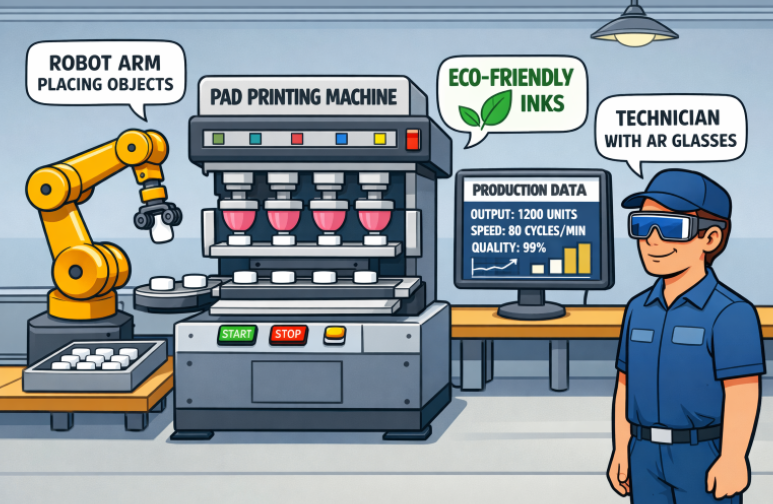
Pad printing has long been a cornerstone in the manufacturing sector, enabling precise and efficient marking on complex and uneven surfaces. As production demands evolve, companies are increasingly investing in advanced pad printing equipment that supports faster setup, consistent output, and seamless integration into automated workflows. Recent innovations continue to reshape the field through smarter controls, sustainable materials, and digital monitoring systems.
Automation and Robotics
The integration of automation and robotics is transforming pad printing. Modern systems feature automatic feeders, robotic part handling, and vision-guided inspection, leading to higher throughput and improved print consistency. For instance, in 2025, ITW Morlock partnered with Fanuc to launch a robotic pad printing cell for automotive switch panels, achieving a 30% reduction in defect rates and a 25% improvement in production speed compared to manual setups.
Further, collaborative robots, or “cobots,” are being utilized for their flexibility in adapting to short production runs, a growing demand in custom and boutique manufacturing sectors. These cobots contribute to reducing repetitive strain injuries among workers while maintaining high precision in repetitive tasks, thus supporting efficient just-in-time manufacturing and agile supply chains.
Eco-Friendly Inks and Sustainability
Environmental concerns are driving the adoption of eco-friendly inks and sustainable practices. Manufacturers are shifting towards low-VOC, water-based, and UV-curable inks to reduce emissions and improve workplace safety. In 2024, Marabu (Germany) launched a new series of solvent-free pad printing inks that reduce emissions by over 60%. Additionally, energy-efficient dryers and recyclable consumables are being implemented to minimize the ecological footprint.
Certifications such as the GREENGUARD and EN 71 for non-toxicity are now sought by manufacturers targeting sensitive sectors like toys and medical devices. Continued R&D is leading to the development of biodegradable pad printing plates and solvent recovery systems that further reduce waste and facilitate more responsible production cycles.
Digital Integration and AI
Digital technologies and AI are enhancing pad printing processes. IoT-enabled machines with real-time defect detection and predictive maintenance reduce downtime by 30%. AI-driven quality monitoring detects print defects in real time, enabling instant corrections and reducing scrap rates. These advancements support Industry 4.0 initiatives, where smart factories demand interconnected and efficient production systems.
Data from pad printing lines is increasingly being fed directly into centralized manufacturing execution systems (MES), granting managers and operators a holistic view of production quality, efficiency, and maintenance needs. This integration enables not just reactive, but proactive and predictive responses to process irregularities, empowering smarter manufacturing at every level.
Multi-Color and High-Resolution Printing
Advancements in multi-color and high-resolution printing are meeting the demand for intricate designs. Manufacturers are rolling out new multi-color, servo-driven pad printers capable of high-definition, multi-layered graphics on small and intricate components. In 2024, Tosh Srl (Italy) launched a 6-color closed-cup pad printer for cosmetic packaging, supporting ultra-fine gradients and metallic inks demanded by luxury beauty brands.
Such improvements are crucial for industries like electronics, medical devices, and promotional items, where detailed logos or markings enhance product identification, traceability, and aesthetic value. The ability to deliver complex, photorealistic prints reliably at scale is rapidly turning pad printing into a preferred method for brand differentiation, even on challenging 3D surfaces.
Hybrid Printing Solutions
Hybrid systems combining pad printing with digital inkjet or laser marking are emerging, giving manufacturers flexibility to apply both static and variable data in a single pass. In 2025, Comec Italia partnered with Domino Printing to offer a hybrid solution for smart packaging and electronic device labeling.
This approach allows for a seamless transition between batch and individual customization, opening new opportunities in the field of personalized products, limited-edition packaging, anti-counterfeiting markings, and interactive consumer engagement through QR codes or smart tags applied during the same print cycle.
Augmented Reality in Operator Training
To combat skill shortages, leading vendors are deploying AR-powered operator training and troubleshooting modules. In 2024, Print Systems UK piloted AR glasses for on-site technicians, resulting in a 40% decrease in operator training time and faster maintenance interventions.
By overlaying step-by-step instructions, live diagnostics, and remote expert support directly onto the operator’s field of view, AR tools are proving invaluable for reducing errors, downtime, and dependency on highly experienced staff. This democratization of technical expertise is crucial as manufacturers adapt to higher staff turnover and evolving health and safety expectations.
Custom Software and AI-Driven Process Optimization
Custom software solutions leveraging machine learning are now being used to automatically optimize pad pressure, ink viscosity, and print speed based on real-time feedback. This trend is helping manufacturers maintain quality while reducing human error and waste.
AI algorithms also allow for rapid changeover between product types and fast adaptation to new substrates, ink formulations, and color requirements, essential for sectors like packaging, where responsiveness to seasonal promotions or changing regulatory conditions can affect the bottom line.
Emerging Applications and Market Demand
Pad printing continues to expand its reach into new industries that require specialized surface decoration. The medical sector, for example, relies on pad printing for marking surgical instruments, syringes, and implantable devices where biocompatibility and clarity are critical. In automotive and aerospace, it is utilized for branding, labeling, and even functional sensor applications.
Furthermore, the rise of wearable tech and IoT-connected devices is creating demand for fine, durable markings on plastics, silicones, and metals of unconventional shapes. As consumer products become more customized and style-driven, the ability of pad printing to handle odd geometries and delicate componentry makes it increasingly attractive compared to alternative decorative techniques.
Future Prospects of Pad Printing
Looking ahead, the trajectory of pad printing innovation is closely aligned with the broader trends shaping advanced manufacturing. As additive manufacturing and microfabrication become more prevalent, pad printing technologies are expected to evolve further to deliver even greater resolution, more efficient workflows, and seamless compatibility with next-generation production lines.
Ongoing research focuses on smart, self-cleaning pads, digital ink matching, and integration with robotics for fully lights-out operations. The convergence of these technologies will likely open up new possibilities for batch-of-one production, hyper-personalization, and just-in-time decoration, paving the way for pad printing to play a pivotal role in future value chains.
Conclusion
The pad printing industry is undergoing significant transformations driven by automation, sustainability, and digital integration. These innovations are enhancing efficiency, precision, and environmental responsibility, positioning pad printing as a vital component in modern manufacturing.
-

 BLOG8 months ago
hanime1: The Ultimate Destination for Anime Lovers
-

 ENTERTAINMENT10 months ago
Sflix: How It’s Changing the Way We Watch Movies and TV Shows
-

 ENTERTAINMENT9 months ago
Crackstreams 2.0: The Future of Free Sports Streaming?
-

 BILLS10 months ago
Why Does My Instagram Reel Stop Getting Views After One Hour? How to Fix It?
-

 BLOG8 months ago
Imginn: The Ultimate Tool to View Instagram Content Anonymously
-

 Technology11 months ago
Simpcitt: The Rise of a Unique Online Community
-

 80s11 months ago
Favorite 100 Songs of the 80s: (#1) Michael Jackson – Billie Jean
-

 BLOG10 months ago
NHentai.nef: Understanding the Popular Hentai Archive