
LAW
Why Case Outcome Tracking Matters When Choosing Legal Representation


Looking for the highest settlement possible from a personal injury compensation claim?
When selecting a lawyer, most people choose based on marketing they see, reviews online, or who a friend recommends. One topic that almost nobody discusses but should be a huge factor in the decision is…
Case outcome tracking.
It’s one of those terms that sounds overly complicated. Truth is, it’s one of the easiest ways to see if a law firm is competent or not.
Law firms that track past case outcomes are able to achieve better results for their clients. Without tracking, a case is essentially being guessed at.
Ready to see what else?
What you’ll discover:
- Why Tracking Case Outcomes Is Powerful
- How It Affects Personal Injury Compensation Claims
- What You Should Expect from A Firm’s History
- Warning Signs That Should Raise Red Flags
Why Tracking Case Outcomes Is Powerful
Start with the basics. What is case outcome tracking? As the name suggests, law firms keep records of each case they handle. This can include the type of injury claim, how much the claim settled for, how long it took to settle, and if it went to trial.
Why should you care?
Not every personal injury compensation claim is created equal. There is a large variance in what different settlements look like based on injury severity, liability, and hundreds of other factors.
So how do you know if the law firm you are looking to represent you can handle the unique details of your case?
Past tracked case outcomes.
Analyzing every past case they’ve worked on allows a law firm to identify patterns and problem areas. When looking for an injury law firm in Dallas to handle a personal injury compensation claim, look for a firm that tracks their case history. It’s the best way to gauge if they consistently produce fair settlements or leave past clients hurting for more.
Here’s a good example…
Say you were injured in a car accident. A law firm that tracks their case outcomes would know:
- What types of settlements typically happen in car accident injuries
- How long these cases usually take to settle
- Which cases are worth going to trial and which ones aren’t
A law firm with no past case tracking? They would have no idea.
How It Affects Personal Injury Compensation Claims
Here is a fact that might surprise you…
Personal injury lawyers learn very early on that approximately 95% of cases settle before trial. According to recent studies, roughly 95% of lawsuits settle before reaching a courtroom. This means the negotiation phase is where most personal injury claims are won or lost.
And that is where past case tracking comes into play.
When a law firm knows the true value of a claim because they have data on similar cases they’ve handled, they can confidently negotiate a higher settlement number. Their past wins serve as leverage against the insurance company pushing back.
Without access to that kind of information, a legal team is flying completely blind.
But wait, there’s more…
Only a fraction of personal injury cases even go to trial. The Bureau of Justice Statistics estimates that only 3 to 4 percent of personal injury lawsuits go before a judge and jury. Knowing when to negotiate and when to push for trial takes great data and experience. Law firms that track past outcomes have that benefit. Ones that don’t are gambling with your case.
What You Should Expect from A Firm’s History
This isn’t something you are going to walk into a law office and ask to see spreadsheets of. But reputable law firms should be able to provide some specifics on their past personal injury compensation cases.
Following are some of the key pieces of information you should expect any law firm to be able to articulate.
Consistent settlements. If a law firm regularly handles personal injury claims, they should be able to show consistency in their settlements. Whether it be car wrecks, workplace accidents, or slips and falls, look for firms that can speak specifically to similar cases like yours.
Time to settle. How long did it take past firms to settle cases like yours? Tracking outcomes can reveal this information. If a law firm takes an unreasonable amount of time to settle simple claims, they likely do not have good case management processes in-house.
Trial experience. Some cases go to trial. Plain and simple. While the majority of cases settle, data from the Department of Justice shows that plaintiffs win about 50% of trials overall. When you look at car accident injury claims specifically, that number jumps to 61%. Any law firm that knows this data should be able to tell you about their trial experience.
Transparent. Extra bonus points for firms that aren’t afraid to show their work and past client outcomes. If they aren’t transparent about their case history during a consultation, expect that to continue once they take the case.
Simple stuff. Promise.
Warning Signs That Should Raise Red Flags
Now take a look at some things firms should be doing that fly in the face of tracking past case results.
- Making promises they can’t keep. If a law firm cannot or will not provide any details about past settlements, walk away.
- Guarantees. Every case is different and dozens of factors go into the value of a case. Any law firm promising a certain settlement dollar amount before they review the case is not being honest.
- Quick settlements. Some lawyers push their clients to settle quickly because that means they get paid quicker. A lawyer with accurate data knows there is a better offer on the table. They will fight for the client.
- Communication. If you have a hard time reaching the law firm during the initial consultation, how are you going to feel once they take the case? Law firms that track outcomes typically have this stuff dialed in.
Case outcome tracking can seem like a small piece of the puzzle. But lawyers who take the time to record past wins and losses are building a knowledge base that benefits every client they take on.
Wrapping it Up: Why Should You Care?
Selecting the right attorney to represent you in a personal injury compensation claim is arguably the most important decision anyone will make after getting injured. Case outcome tracking is one of the best methods for separating great law firms from ones that you want to avoid.
A quick review of what was covered:
- Case outcome tracking reveals how a law firm has performed in past cases
- Tracking case wins and losses gives lawyers data to leverage during negotiations
- Past case tracking allows firms to settle claims faster and for higher amounts
- Law firms that track should be transparent about their past results
Because the majority of personal injury claims settle outside of trial, the negotiation with the insurance company is the biggest opportunity to win. A law firm that has a track record proving their negotiation skills walks into that conversation ready to win.
Don’t leave a personal injury claim up to chance. Do the research. Ask the tough questions. And select a law firm that can prove they’ve fought for clients just like you in the past.
Only then can you rest easy knowing the case is in good hands.
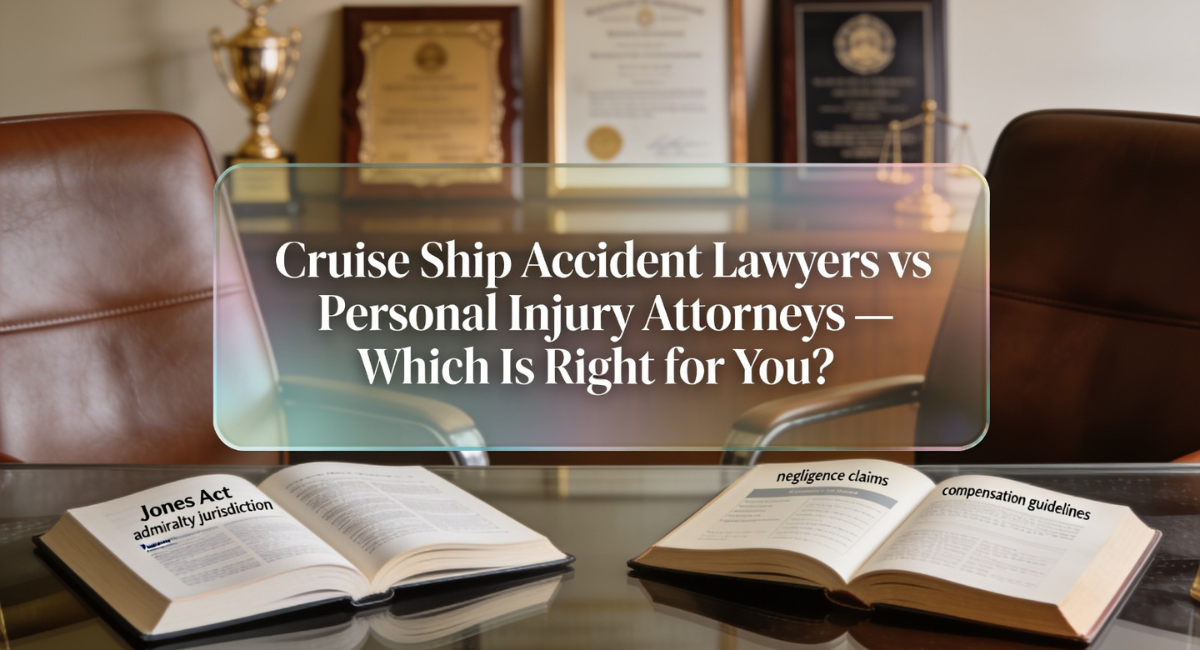
You’ll need a cruise ship accident lawyer, not a general personal injury attorney. Maritime law governs cruise incidents differently than land-based accidents, with unique statutes like the Jones Act and liability limitations that generalists often miss.
Cruise contracts contain complex arbitration clauses and forum-selection provisions requiring specialized expertise. Without maritime knowledge, you’ll risk overlooking critical deadlines, undervaluing your claim, and failing to challenge unfair contract terms. Understanding these distinctions could greatly impact your compensation outcome.
When Do You Need a Cruise Ship Accident Lawyer?
Why’d you get injured on a cruise ship when you thought you’d signed up for relaxation? You’ll need a cruise ship accident lawyer when you’ve suffered injuries aboard a vessel and want to pursue compensation.
These specialized attorneys understand maritime law, which differs greatly from standard personal injury cases. You should hire one if you’ve experienced slip-and-falls, food poisoning, cabin negligence, or other shipboard incidents.
Cruise ship accident lawyers know the Jones Act, limited liability doctrines, and international maritime regulations that apply to your claim. They’re essential when cruise lines deny responsibility or offer inadequate settlements.
These attorneys navigate complex jurisdictional issues and negotiate with cruise companies’ legal teams. Without specialized expertise, you’ll likely struggle against corporations with extensive maritime legal resources.
Maritime Law vs. Personal Injury Law: What’s Actually Different?
Because cruise ship incidents fall under maritime law rather than standard personal injury law, you’re operating in an entirely different legal framework.
Maritime law applies specific statutes, including the Jones Act and Death on the High Seas Act, which don’t exist in traditional personal injury cases.
You’ll face unique liability limitations and damage caps that differ appreciably from land-based accidents.
Maritime courts follow precedents and procedures unfamiliar to general personal injury attorneys.
Jurisdictional issues become complex—determining which country’s laws apply depends on where the ship was registered and where the incident occurred.
Your attorney must understand admiralty principles, maritime contracts, and cruise line regulations.
They’ll need expertise maneuvering international treaties and specific cruise industry standards.
Without this specialized knowledge, you’ll miss vital legal advantages and protections available only through maritime law expertise.
Why Cruise Line Contracts Require Specialized Legal Knowledge
Cruise line contracts contain deliberately complex provisions that most general attorneys won’t recognize or know how to challenge.
You’ll encounter arbitration clauses that force disputes into private proceedings rather than courts, liability limitations that cap damages, and forum-selection clauses requiring you to sue in specific jurisdictions—often favorable to the cruise line.
These agreements include technical maritime law references and indemnification language designed to protect the cruise company.
A specialized cruise ship accident lawyer understands these tactics and knows how to identify enforceable versus unenforceable terms. They’re familiar with international maritime conventions that apply to your case.
General personal injury attorneys lack this specialized knowledge.
You need someone who regularly negotiates cruise line contracts and understands the legal loopholes embedded within them.
Red Flags That Prove You Need Maritime Expertise
When your case involves injuries occurring on international waters, you’ll quickly discover that standard personal injury litigation won’t suffice. Several red flags signal you’re dealing with maritime complexities requiring specialized expertise.
First, if your accident happened beyond territorial waters, federal maritime law supersedes state regulations. You’ll need someone versed in admiralty law’s unique statutes and precedents.
Second, when the cruise line invokes liability waivers or arbitration clauses buried in your booking contract, you’re entering specialized legal territory.
Third, if your claim involves foreign ports or international waters, jurisdictional issues become complicated fast.
Additionally, if the cruise line denies responsibility based on maritime employment classifications or tries limiting damages under maritime law caps, you’re facing distinctly nautical legal arguments.
These situations demand maritime expertise standard personal injury attorneys simply don’t possess. Recognizing these red flags early guarantees you secure appropriate legal representation.
Where Generalists Stumble: Common Admiralty Law Mistakes
General personal injury attorneys frequently mishandle maritime cases by applying state tort principles where federal maritime law governs, fundamentally undermining their clients’ claims.
You’ll encounter mistakes like overlooking the Jones Act’s specific employee protections or neglecting to invoke maritime negligence standards.
Generalists often miss filing deadlines tied to federal admiralty rules, costing you critical legal ground.
They misunderstand limitation of liability clauses embedded in cruise contracts, failing to challenge them effectively.
Many don’t recognize when you’re entitled to maintenance and cure benefits—ongoing living expenses and medical care maritime employers must provide.
Additionally, generalists frequently bungle damage calculations, unaware that maritime law permits different recovery categories than standard personal injury cases.
These oversights directly diminish your settlement value and weaken your negotiating position.
Questions to Ask Your Cruise Ship Accident Lawyer
How do you separate a qualified cruise ship accident lawyer from a generalist who’ll apply landlocked legal principles to your maritime claim?
Ask directly about their admiralty law experience.
Request specific cases they’ve handled involving cruise ship incidents.
Inquire about their familiarity with international maritime law and the Jones Act.
Find out if they understand cruise line liability limitations and passenger ticket contracts.
Ask whether they’ve negotiated with major cruise lines before.
Determine if they know federal maritime jurisdiction and venue issues.
Request references from former cruise ship accident clients.
Ask about their success rate and typical settlement ranges.
Finally, clarify their fee structure and whether they’ll pursue claims in foreign ports.
These questions reveal whether you’re hiring genuine maritime expertise or settling for inexperienced representation.
Conclusion
You’re maneuvering treacherous waters when you choose between a cruise ship accident lawyer and a general personal injury attorney. Maritime law’s complexities aren’t just different—they’re a whole separate beast. Don’t gamble with your case by hiring someone unfamiliar with admiralty regulations and cruise line contracts. You’ll want specialized expertise in your corner to guarantee you’re not left stranded without proper compensation.

Navigating the criminal court process can be intimidating for anyone, especially first-time offenders with no prior experience with the justice system. From the initial charge to potential sentencing, each phase of the process involves important decisions that can significantly impact a person’s future. Consulting with a skilled Wilmington Island criminal defense attorney can help ensure your rights are protected and that you make informed choices every step of the way.
It is crucial to understand what occurs during each stage of the criminal court process. Knowing what to expect not only reduces anxiety but also helps in preparing a strong defense. Whether you are looking at the possibility of diversion programs or considering how new legislation might affect bail conditions, being informed puts you in a better position to achieve a favorable outcome.
The Arrest and Formal Charges
The criminal court process typically begins with an arrest. Law enforcement must have probable cause to believe a crime was committed. Once arrested, a person is taken into custody and may be booked at the police station, where personal details and fingerprints are collected. Formal charges are then brought against the defendant, either by a prosecutor filing an information or through a grand jury indictment.
After charges are filed, the accused is informed of the specific offenses and must begin preparing a defense. It is important to take these initial steps seriously, as what happens here can affect every phase of the process later. Early involvement of legal counsel helps to ensure that evidence is preserved and that your rights are fully asserted from the beginning.
Arraignment and Bail Decisions
The arraignment is the initial court appearance where defendants learn the charges and are informed of their rights, while bail or pretrial release conditions are discussed. Recent legislative changes, such as Georgia’s Senate Bill 63, have tightened bail requirements, limiting judges’ discretion to grant release on recognizance. If bail is set, it can be posted in cash, via a bonding company, or with property. Denied or unaffordable bail means the defendant remains in custody, which can significantly affect defense preparation and participation in case strategy.
Pre-Trial Hearings and Motions
Before trial, several pretrial hearings may be held. These hearings address issues such as the admissibility of evidence, constitutional violations, or requests for dismissal. Defense attorneys often file motions to suppress evidence obtained unlawfully or to dismiss the case for procedural defects. This is also the period in which plea negotiations commonly occur.
Plea bargaining allows the defendant to resolve the case without going to trial, often with reduced charges or a lighter sentence. In some cases, programs such as pretrial diversion or eligibility under the First Offender Act are considered. These alternatives can provide a second chance for qualifying defendants, allowing successful participants to avoid a formal criminal record.
The Trial Process
If the case is not settled through a plea, it will proceed to trial. Criminal trials can be either before a judge (bench trial) or, most commonly, before a jury. Both sides present evidence and call witnesses. The prosecution must prove the defendant’s guilt beyond a reasonable doubt. After all evidence has been presented, the jury or judge deliberates and delivers a verdict of guilty or not guilty.
A guilty verdict leads to sentencing. An acquittal means the defendant is free to go and cannot be tried again for the same offense. If the jury cannot reach a unanimous decision, it may result in a mistrial, and the prosecution must decide whether to retry the case.
Sentencing and Alternative Outcomes
After a conviction, either through a trial verdict or guilty plea, sentencing occurs. The judge will consider multiple factors, including the nature of the offense, the defendant’s history, and victim impact statements, if applicable. For first-time, non-violent offenders, programs like Georgia’s First Offender Act offer a way to avoid a permanent criminal record if certain conditions are met. Under this law, eligible defendants may plead guilty and, upon successful completion of probation or other sentences, avoid a conviction in most record checks.
Pretrial diversion programs are another path for some, focusing on rehabilitation rather than punishment. These may include counseling, community service, and regular monitoring. Successful completion often leads to charges being dismissed altogether. Legislative developments and changing attitudes toward criminal justice mean these options are increasingly available, although typically only for less serious, nonviolent offenses.
The Importance of Legal Representation
Throughout the criminal court process, an experienced defense attorney is essential. Legal counsel can help you understand your charges, your rights, and your available options as you negotiate for favorable outcomes, such as reduced sentences, plea deals, or participation in diversion programs. A knowledgeable advocate also ensures compliance with court requirements, helping to avoid violations that could worsen your situation. The guidance and support of a dedicated attorney can mean the difference between a devastating outcome and a fresh start.
Conclusion
The criminal court process involves many stages, each with its own challenges and opportunities. First-time offenders in Georgia may have access to programs and legal options such as the First Offender Act and pretrial diversion, which can prevent a lifelong criminal record. Understanding the structure and expectations of each phase is vital, and working with a skilled attorney provides the best chance for a positive resolution. Being proactive and informed helps you navigate this difficult time with clarity and confidence.

Family legal issues often arrive at the most stressful moments in a person’s life. Whether they involve separation, child custody, or financial disputes, the emotional weight can feel overwhelming. During these times, finding the right kind of support becomes just as important as understanding the legal process itself.
Many people worry about cost while also hoping for someone who truly understands their situation. The search for an affordable family law attorney can feel like a balancing act between budget and quality. It is not just about finding someone who charges less, but someone who provides clear advice, reliable support, and good value.
Choosing the right legal help is not a decision to rush. Taking time to understand what matters most can make the entire process smoother and less intimidating. With the right approach, families can feel more confident throughout the legal process, even in difficult situations.
Understanding Experience and Specialization
Why Family Law Focus Matters
Not all lawyers handle family cases the same way. Some may have general legal experience, but family law requires a deeper understanding of sensitive issues like custody, support, and family related disputes. A lawyer who focuses on family law is more likely to approach cases with both legal knowledge and an understanding of the emotional challenges involved.
Clients often feel more at ease when they know their attorney has handled similar situations before. This familiarity can help reduce uncertainty and lead to more practical solutions. It also allows the lawyer to anticipate challenges and guide their clients with greater confidence.
Looking at Past Cases and Client Experiences
A lawyer’s track record can offer helpful insight into how they work. While no two cases are exactly alike, past experiences can show how they handle negotiations, conflicts, and resolutions. Reading client feedback or testimonials can also reveal how approachable and responsive they are.
People often appreciate lawyers who listen carefully and explain things in simple terms. Family legal matters can be confusing, so having someone who communicates clearly can make the process easier to understand. It helps clients feel more informed and less overwhelmed.
Balancing Cost and Quality
Affordability does not always mean choosing the lowest price. It often means finding someone who offers fair rates while still delivering reliable service. Some lawyers provide flexible payment options or clear pricing, which can ease financial stress.
Clients should feel comfortable asking about fees upfront. Honest conversations about cost can prevent misunderstandings later on. When pricing is clear and reasonable, it becomes easier to focus on resolving the legal matter rather than worrying about unexpected expenses.
Communication and Personal Connection
Clear Communication Builds Trust
One of the most important qualities in a family lawyer is the ability to communicate well. Clients need regular updates, honest advice, and explanations they can understand. Without this, even simple legal steps can feel confusing.
A lawyer who responds promptly and takes time to explain options helps build trust. This is especially important in emotionally charged situations where decisions can have long lasting effects. Strong communication allows clients to feel supported throughout the process.
Feeling Heard and Respected
Family legal issues are deeply personal. People are not just looking for legal answers but also for someone who respects their concerns. A good lawyer listens without judgment and takes time to understand the full picture.
This connection can make a stressful situation feel more manageable. When clients feel heard, they are more likely to share important details and work together to find solutions. It creates a more positive experience, even during difficult times.
Making a Thoughtful Choice
Choosing the right legal help is not just about qualifications or cost alone. It is about finding someone who combines experience, clear communication, and a genuine understanding of family dynamics. These qualities work together to create a supportive and effective legal experience.
Taking the time to research, ask questions, and reflect on what feels right can lead to better outcomes. Families deserve guidance that respects both their legal needs and emotional well being. With the right support, even complex situations can become easier to manage and less intimidating.
In the end, the goal is not just to resolve a legal issue but to move forward with clarity and confidence.
-

 BLOG12 months ago
hanime1: The Ultimate Destination for Anime Lovers
-

 ENTERTAINMENT1 year ago
Sflix: How It’s Changing the Way We Watch Movies and TV Shows
-

 BILLS1 year ago
Why Does My Instagram Reel Stop Getting Views After One Hour? How to Fix It?
-

 ENTERTAINMENT1 year ago
Crackstreams 2.0: The Future of Free Sports Streaming?
-

 BLOG1 year ago
Imginn: The Ultimate Tool to View Instagram Content Anonymously
-

 BLOG11 months ago
ThisVid: What Makes It Stand Out in the World of Online Videos
-

 BLOG1 year ago
NHentai.nef: Understanding the Popular Hentai Archive
-

 Technology1 year ago
Simpcitt: The Rise of a Unique Online Community