
BLOG
How to Document Evidence After an Unexpected Accident ?


Unexpected accidents can happen in a matter of seconds, leaving people overwhelmed and unsure of what to do next. While your immediate focus should always be on safety, the actions you take afterward can also play an important role in protecting your health, finances, and legal rights. Knowing how to document the incident properly can make the recovery process much smoother.
Accurate records help create a clear picture of what happened and provide valuable support when dealing with insurance companies or legal claims. From taking photos at the scene to keeping medical records and repair documents, every detail matters. This guide explains the essential steps to collect, preserve, and organize accident evidence effectively.
Key Steps to Document Accident Evidence with Precision
Accidents can leave you feeling overwhelmed, making it easy to overlook important details. Taking a few simple steps to document the scene and preserve evidence can protect your rights and strengthen your insurance or legal claim. Acting quickly and staying organized can make a significant difference later.
Prioritize Safety and Medical Care
Your first job is not to build a case. It’s to stay alive and prevent more harm.
Move out of traffic if you can do so safely. Call 911. Check yourself and others for injuries. If emergency responders recommend treatment, take it seriously.
And yes, get checked even if you feel “mostly fine.” Adrenaline is sneaky. Neck pain, back pain, headaches, and soft-tissue injuries may not fully show up until hours or even a day later.
Medical records can become some of the strongest evidence in your file. They connect the accident to your injuries, treatment plan, work restrictions, and recovery timeline.
Capture the Scene Clearly
Once everyone is safe, use your phone. Take more photos than you think you’ll need. Future-you will be grateful.
Photograph vehicle positions, license plates, road signs, skid marks, broken glass, debris, traffic signals, nearby businesses, weather, visible injuries, and damage from several angles. Start wide so the scene makes sense. Then move closer for details.
The point is to document accident evidence before tow trucks arrive, vehicles are moved, rain washes marks away, or witnesses leave.
If your phone allows it, keep location settings on. Time and location data can help support your version of events later.
Preserve Physical and Digital Items
Don’t toss damaged clothing, cracked glasses, broken child seats, helmets, phone mounts, or vehicle parts. These items may show force, direction, or impact in a way photos cannot.
Put them somewhere safe. Don’t wash or repair them unless you have documented them first. Also, back up your photos and videos the same day by saving them to cloud storage, emailing them to yourself, or storing them on another device.
Once you’ve handled the basics, you can start building evidence that is easier to understand and harder to dispute. If you’re unsure which records could be most valuable for your case, consulting an injury lawyer Williamsburg VA can help you organize the evidence and better understand your legal options.
Proven Accident Evidence Tips Every Driver Should Know
After the scene is photographed, think about people and cameras. Both can help confirm what happened after memories start to blur.
Gather Witness Statements
If someone saw the crash, ask for their name and phone number. If they’re willing, ask for a short description of what they saw.
Keep it simple. Don’t argue. Don’t coach them. Don’t say, “Tell them the other driver was speeding,” even if you believe that’s true.
Try something calm like: “Could you briefly say where you were and what you saw?”
That one question can be enough. These accident evidence tips help keep witness information useful, fair, and believable.
Save Dashcam and Camera Footage
If you have a dashcam, save the footage immediately, as many devices automatically overwrite older recordings. Also, check nearby businesses, homes, parking lots, or traffic cameras that may have captured the accident. Preserving video evidence as early as possible can provide a clear and reliable record of what happened.
Build a Clean Documentation File
Create one folder for everything related to the crash. Include police reports, medical bills, discharge papers, repair estimates, prescriptions, insurance emails, photos, and witness details.
Name files clearly. “ER-discharge-05-14” is better than “IMG_8472” or “paper thing.”
If you’re searching for evidence after a car accident, don’t think of it as one magic document. Think of it as a full picture. Each piece should support the others.
Once your witness information, video, and paperwork are organized, your own written account becomes the thread tying everything together.
How to Record Accident Details That Stand Up in Court
A strong accident account is not dramatic. It’s not polished. It’s factual, short, and written while your memory is still fresh.
Don’t guess. Don’t fill in blanks. If you don’t know something, say you don’t know.
Write a Factual Incident Narrative
Write down where you were going, the time of day, the traffic flow, weather, road condition, lane position, and what you noticed right before impact.
Include what people said afterward, but keep it exact. If you only remember the general idea, make that clear.
If you’re unsure what to do after an accident, write your notes before talking about fault online, arguing with another driver, or giving long explanations to anyone.
A basic note might say: “I was stopped at the red light on Richmond Road. It was raining lightly. I felt an impact from behind. The other driver said, ‘I didn’t see you stop.’”
That’s simple. That’s useful.
Use Technology Wisely
Voice notes can help if your hands are shaking or you’re waiting for help. Scanning apps can save medical forms, police exchange sheets, receipts, and repair paperwork.
Here’s a quick comparison of common tools:
| Tool | Best Use | Watch Out For |
| Phone photos | Scene, injuries, damage | Blurry or missing wide shots |
| Voice notes | Fresh memories | Emotional wording |
| Cloud folders | Backup and sharing | Poor file names |
| Dashcam clips | Movement and impact | Auto-deletion |
Your notes do not need to sound like a legal brief. Honestly, they shouldn’t. They just need to be dated, accurate, and consistent.
When your story and records line up, official documents can add even more weight.
Essential Actions to Take After an Accident
Personal notes are helpful, but official records often carry extra credibility. Police officers, doctors, employers, and repair shops all create documents that may support your claim.
Request Official Records
Ask how to get the police report and incident number. Save the officer’s name if available.
Keep copies of discharge papers, imaging results, prescriptions, follow-up instructions, medical referrals, and work restriction notes. If your doctor tells you not to lift, drive, stand, or work for a certain period, get it in writing.
These records help show the timeline from crash to treatment. They also make it easier to respond when an insurance company asks for proof.
Be Careful With Insurance Conversations
You should report the accident. But be careful about giving broad guesses on injuries, fault, speed, or what you “probably” could have done differently.
Pain can get worse after the first day. Details can be misunderstood. Early statements may be used against you later.
If an adjuster asks for a recorded statement, pause. Review your documents first. A careful answer is usually better than a fast one.
Once official records are underway, a few extra steps can strengthen your file even more.
Advanced Strategies for Stronger Accident Proof
Not all evidence is obvious at the crash scene. Some of it shows up in your daily life afterward.
Pain patterns, sleep problems, missed routines, and phone data may help explain how the accident affected you.
Use Journals, Not Social Media
A private recovery journal can be surprisingly useful. Keep entries short and dated. Note pain levels, sleep issues, missed events, doctor visits, medication side effects, and limits on normal activities.
For example: “Couldn’t sit through dinner without lower back pain.” That kind of note may matter later.
Social media is a different story. Be careful there. A smiling photo, vacation post, or joke can be pulled out of context. Even if it has nothing to do with your injury, it may create confusion.
When in doubt, keep crash details offline.
Consider Wearable and Phone Data
Fitness watches and phones may show changes after the accident, such as lower step counts, poor sleep, or unusual activity patterns. That data does not replace medical care. But it may support your timeline.
Save screenshots or exports when available. Don’t edit them or cherry-pick only the best parts. Complete records tend to be more credible than carefully selected snippets.
These added layers can help, but a few simple mistakes can still weaken otherwise strong proof.
Evidence After Car Accident: Avoiding Critical Mistakes
Even solid claims can run into trouble because of missing files, rushed statements, or careless posts. The good news? Most evidence problems are preventable.
Avoid Common Pitfalls
Don’t leave the scene without exchanging information. Don’t skip medical care. Don’t rely only on memory. Don’t delete photos after sending them to insurance. And don’t exaggerate.
A folder named evidence after a car accident can help keep everything in one place. Save originals, copies, and notes separately when you can.
Also, don’t assume “minor damage” means minor injury. Bodies and bumpers do not always tell the same story.
Use a Simple Checklist
Before leaving the scene, make sure you have photos, witness details, insurance information, police contact information, and a plan for medical follow-up. Later, add bills, emails, repair estimates, prescriptions, and updated medical notes.
These accident evidence tips work best when they’re simple enough to follow while you’re stressed. Because let’s be honest, nobody feels organized five minutes after a crash.
A checklist turns chaos into a process. That can make your next step much clearer.
Conclusion
Documenting evidence after an unexpected accident is one of the most effective ways to protect your health, finances, and legal rights. From photographing the scene and preserving physical evidence to keeping medical records and organizing official documents, every step strengthens your claim.
Acting quickly, staying accurate, and avoiding common mistakes can make a significant difference when dealing with insurance companies or legal proceedings. By following these best practices, you’ll create a clear, credible record of the incident and put yourself in a stronger position to recover with confidence.
Common Questions About Documenting Accident Evidence
Which types of evidence matter most after a Virginia car accident?
Photos, medical records, police reports, witness statements, repair estimates, and video footage often matter most. The strongest file usually includes several types of proof that support the same timeline from different angles.
Should I collect evidence if the other driver admits fault?
Yes. Admissions can change later, especially once insurance companies get involved. Still collect photos, witness names, medical records, and official reports so your claim doesn’t depend only on what someone said at the scene.
What if I lose accident photos or videos?
Check cloud backups, recently deleted folders, text threads, email attachments, and dashcam memory cards. If footage came from a business or nearby property, ask quickly before it’s erased or recorded over.

Bodenxt is an unusual search term that offers an opportunity to explore how unfamiliar names attract attention across the internet. As digital platforms continue to introduce new brands, creative projects, online identities, and expressions, people regularly encounter words they cannot immediately identify. Bodenxt raises questions about this process and highlights the importance of understanding the context behind unfamiliar search queries.
The internet makes discovering new information easier than ever, but not every term has a clear definition or established public background. Some names belong to emerging businesses, while others appear in limited discussions or are created for specific online communities. Without reliable evidence, it is important not to assign Bodenxt a meaning that has not been confirmed.
Examining this term from a digital perspective provides useful insight into search habits, online curiosity, and the ways publishers can create informative content. It also demonstrates why accurate research matters when an unfamiliar keyword becomes the focus of an article.
What Makes Bodenxt Worth Exploring?
Unfamiliar words can attract attention because they leave room for questions. When readers encounter a name they do not recognize, they may wonder whether it represents a website, product, company, username, or newly developed concept.
Bodenxt has the characteristics of a distinctive search phrase, but its spelling alone cannot establish its origin or purpose. Identifying its actual meaning requires relevant context, reliable references, and evidence connecting the term to a specific subject.
This uncertainty is not unusual in the digital world. New names appear frequently, and some remain difficult to identify until their creators or users provide more information.
For readers, investigating such terms can be an exercise in digital literacy. Instead of accepting the first explanation they encounter, they can compare sources and determine whether the available information supports a consistent conclusion.
Bodenxt and the Psychology of Online Curiosity
Curiosity influences how people interact with digital information. A strange name, unfamiliar phrase, or unexpected reference can encourage someone to open a search engine and investigate further.
Why unfamiliar terms attract attention
People often search for information when something does not fit their existing knowledge. A familiar word may immediately suggest a meaning, while an unfamiliar expression creates uncertainty.
Bodenxt may prompt questions about its identity, background, or relevance. Someone might have seen it in a discussion, encountered it on a webpage, or received it from another person. Each situation creates a different reason to investigate.
This behavior illustrates an important feature of internet usage: searches are not always driven by a practical need. Sometimes, people simply want to understand something they have noticed.
How repeated exposure affects recognition
A term can become more recognizable when people encounter it repeatedly. Seeing the same expression across different pages may encourage further investigation.
However, repetition does not automatically establish credibility. Multiple websites may reproduce identical information without independently verifying it. A name appearing in search results therefore does not prove that it belongs to a reputable company or widely used service.
Readers should examine the origin of claims and look for independent confirmation before drawing conclusions.
Bodenxt in Search Engine Optimization
Search engine optimization, commonly known as SEO, helps publishers make relevant information easier to discover. A well-organized article communicates its subject clearly while addressing the questions readers are likely to ask.
Understanding search intent
Search intent refers to the reason someone enters a particular query. A person searching for Bodenxt may want to understand its meaning, identify a possible website, or discover where the term originated.
A useful article should respond to these possibilities without pretending to know more than the evidence supports. When a term has an unclear background, acknowledging that uncertainty is more valuable than inventing a detailed explanation.
Publishers can improve their content by researching the available context and identifying the most reasonable questions behind the search.
Using Bodenxt naturally in content
Including the target keyword in the title, opening paragraph, and relevant headings helps establish the article’s subject. However, repeating it in every sentence can make the writing feel artificial.
Related phrases such as online discovery, unfamiliar search terms, digital visibility, and search behavior can expand the discussion naturally.
Good SEO writing prioritizes clarity and usefulness. Keyword placement should support the article rather than determine every sentence. Readers should finish the page with a clearer understanding of the subject and the limitations of the available information.
How to Research Bodenxt Effectively
Research is especially important when an unfamiliar term lacks a well-established meaning. A few practical steps can help readers identify reliable information.
Start with the exact term
Search for the precise spelling of Bodenxt before exploring variations. Exact searches can reveal whether the term appears consistently across different sources or is associated with several unrelated subjects.
Pay attention to the context surrounding each result. A relevant article, an official business page, and an unrelated discussion do not provide the same kind of evidence.
Look for original sources
If Bodenxt appears to represent a company, service, or product, search for an official website or credible documentation. Original sources can clarify how a name is used and what an organization claims to offer.
Independent reporting and relevant public records may provide additional confirmation. Nevertheless, an official page should not automatically be treated as proof of every claim about security, reputation, or business performance.
Check the accuracy of published information
Publication dates matter because websites and online identities can change. Older pages may describe services that are no longer available or provide details that have since become inaccurate.
Compare important claims, check their sources, and distinguish confirmed facts from speculation. If reliable information about Bodenxt remains limited, state that limitation clearly.
Common Mistakes When Discussing Bodenxt
One mistake is inventing a definition simply because a keyword needs an explanation. Although this approach can produce a detailed article, it risks misleading readers and undermining trust.
Another mistake is assuming that an unusual name represents a successful digital brand. A distinctive spelling does not confirm commercial activity, public recognition, or an established online service.
Some publishers also focus too heavily on keyword density. Repeating the same phrase throughout an article may satisfy a superficial checklist, but it does not necessarily improve readability or search performance.
A stronger approach combines relevant keyword placement with useful explanations, careful research, and transparent language. Each section should add information rather than restate earlier points.
The Future of Digital Discovery and Bodenxt
The digital landscape continues to evolve as new websites, applications, businesses, and online communities emerge. Distinctive names can gain attention through social sharing, creative projects, product launches, or simple curiosity.
Some unfamiliar terms eventually develop recognizable identities. Others remain associated with a small audience or disappear from public attention. Their long-term significance depends on how people use them and whether credible information becomes available.
Bodenxt provides an opportunity to consider these patterns without assuming a particular outcome. For publishers, unfamiliar keywords can inspire useful research, provided that the resulting content answers genuine questions and avoids unsupported claims.
As search technology improves, the distinction between simply mentioning a keyword and genuinely explaining a subject will remain important. Content that combines relevance, accuracy, and context is more useful than pages created solely to capture search traffic.
Conclusion
Bodenxt illustrates how an unfamiliar online term can encourage questions about meaning, identity, and digital visibility. Investigating such a keyword requires more than examining its spelling or counting the number of pages that mention it.
Reliable research involves checking original sources, comparing evidence, and recognizing when information remains uncertain. These habits help readers navigate the internet more confidently and allow publishers to create content that deserves their audience’s trust.
For SEO professionals, the broader lesson is straightforward: successful content should address real search intent, use keywords naturally, and provide meaningful information. An unfamiliar term may inspire curiosity, but accurate explanations are what make that curiosity worthwhile.
Ultimately, the most responsible way to approach Bodenxt is to investigate its available context rather than assign it an unsupported identity. Clear communication and credible evidence remain essential to meaningful online discovery.
Frequently Asked Questions
1. What does Bodenxt mean?
The exact meaning of Bodenxt has not been established by the information available for this article. Additional context or a reliable source would be necessary to identify a specific definition.
2. Why might people search for Bodenxt?
People may search for unfamiliar terms after encountering them on websites, social media, online discussions, or other digital platforms.
3. Is Bodenxt a website or a brand?
The keyword alone does not confirm that Bodenxt represents a particular website, company, or product. Reliable documentation would be needed to establish its identity.
4. How can I research Bodenxt online?
Start with an exact-match search, review credible sources, check publication dates, and compare the contexts in which the term appears.
5. Can Bodenxt be used as an SEO keyword?
Yes. It can serve as a target keyword when the content addresses the subject meaningfully and avoids excessive repetition or unsupported claims.
6. What makes content about unfamiliar keywords valuable?
Valuable content explains the available context, answers relevant questions, distinguishes verified facts from uncertainty, and helps readers find trustworthy information.
SFMCompile is a term associated with preparing custom 3D assets for Source Filmmaker, an animation application developed by Valve. For digital artists, animators, and gaming enthusiasts, understanding SFMCompile can make it easier to turn creative models into usable elements for animated scenes. The process connects 3D modeling with the technical requirements of the Source engine, allowing creators to work with custom characters, props, and other assets.
The term can also appear as the name of an online resource focused on this workflow. Its precise meaning therefore depends on the context in which it is used. In technical discussions, it generally refers to asset compilation rather than a single universal feature. Understanding the difference helps beginners find relevant tutorials, choose suitable tools, and avoid confusion when researching animation techniques.
What Is SFMCompile?
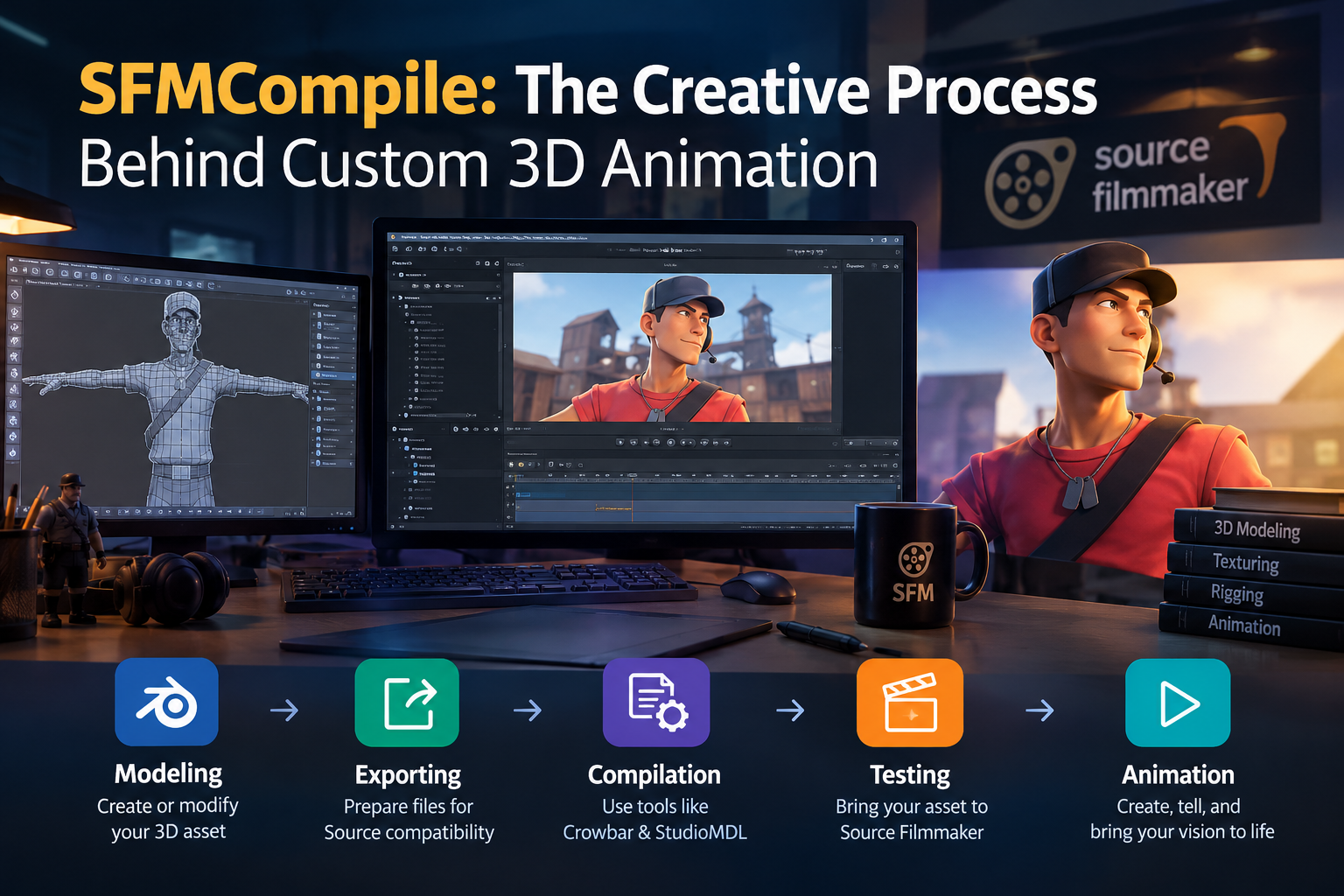
SFMCompile describes the process of converting prepared model files into formats that classic Source Filmmaker can recognize. Models created in applications such as Blender or Maya usually require additional preparation before they can function correctly inside SFM.
This process involves exporting model data, organizing materials, defining model settings, and using appropriate compilation software. The resulting files allow the Source engine to load the asset with its geometry and other supported properties.
SFMCompile is not simply another name for creating a 3D model. Modeling determines an object’s appearance and structure, while compilation prepares the asset for use within a compatible environment.
For beginners, recognizing this distinction provides a useful foundation for learning the technical side of animation.
How SFMCompile Works in a Typical Workflow
A successful compilation workflow involves several connected stages. Each stage contributes to the final result, and problems with one component can prevent the model from working correctly.
1. Preparing the model
The process begins in a 3D modeling application. Artists create or modify a character, object, or prop, checking its geometry, scale, materials, and structure before exporting it.
Characters may also require a suitable skeleton for animation. Incorrect bone assignments or inconsistent model settings can create problems later, so preparation deserves careful attention.
2. Exporting compatible files
After preparation, the model must be exported into a format supported by the intended Source engine tools. Common formats used in classic Source model workflows include SMD and DMX.
The appropriate format depends on the asset and the tools being used. Export settings should preserve the information needed for the model, including geometry and, where applicable, skeletal or animation data.
3. Creating compilation instructions
A QC file provides instructions to the model compiler. It can define the model’s output location, source meshes, material paths, and other settings.
Incorrect file references or missing source assets can cause compilation errors. Keeping project folders organized and checking paths before compiling can reduce unnecessary troubleshooting.
4. Compiling and testing
A tool such as StudioMDL performs the model compilation, while Crowbar provides a graphical interface for common Source model tasks. A successful compilation produces the model files needed by the relevant engine workflow.
The final step is testing the asset inside Source Filmmaker. Creators should check whether the model loads correctly, displays its materials, and behaves as expected.
Essential Tools for SFMCompile
Several tools can support the SFMCompile workflow, although the exact setup depends on the project.
Source Filmmaker: Valve’s animation software provides the environment in which creators assemble scenes, position characters, adjust cameras, and create animations.
Blender: This 3D application helps artists model, rig, and prepare assets before exporting them for compatible workflows.
Blender Source Tools: This add-on supports Source-compatible model export from Blender, including formats used in traditional Source pipelines.
Crowbar: This community tool offers a graphical interface for compiling and decompiling supported Source models.
StudioMDL: Valve’s model compiler converts prepared model data and compilation instructions into Source-compatible model files.
Each tool has a different role. Selecting compatible versions and following documentation for classic Source Filmmaker helps prevent confusion between older Source workflows and newer Source 2 tools.
Common SFMCompile Problems and Their Solutions
Even a carefully prepared model can encounter technical issues. Understanding common problems makes troubleshooting more manageable.
Missing textures
A model may appear with a purple-and-black checkerboard pattern when its materials or textures cannot be located correctly. Check the material paths, VMT files, VTF textures, and relevant directory structure.
Compilation errors
Compilation may fail because a source file is missing, a QC instruction is incorrect, or an export contains incompatible information. Reviewing the compiler log can help identify the source of the problem.
Broken character rigs
A character might appear in an unexpected pose or fail to animate properly. Check the skeleton, bone assignments, and exported animation data. Testing a simple version of the model can help isolate the issue.
Models that do not appear in SFM
If compilation finishes but the asset remains unavailable, verify the output directory and model path. Also check whether the model files are in the correct game folder and whether Source Filmmaker needs to be restarted.
Making one change at a time helps identify the cause instead of introducing additional problems during troubleshooting.
Why SFMCompile Matters to Digital Creators
SFMCompile gives artists a way to bring custom assets into established animation workflows. Instead of depending exclusively on existing characters and props, creators can prepare compatible models that better match their ideas.
This flexibility is useful for fan animations, short films, visual experiments, gaming-related projects, and personal storytelling. Custom assets can help creators develop distinctive scenes that would be difficult to produce using only default resources.
The workflow also encourages artists to learn skills beyond modeling. Understanding export formats, material organization, file structures, and compilation logs can improve their technical confidence.
However, successful compilation does not automatically guarantee good animation. Composition, lighting, timing, camera movement, and storytelling remain important parts of producing a polished final project.
Best Practices for a Better SFMCompile Experience
A few practical habits can make the workflow easier to manage.
- Keep source models, exported files, textures, and QC scripts organized.
- Use descriptive filenames and consistent folder structures.
- Test simple assets before attempting complicated characters.
- Read compilation logs instead of repeatedly running the same failed process.
- Back up original project files before making significant changes.
- Check permissions and licensing before using or redistributing third-party assets.
- Consult documentation that matches the specific Source engine version.
These practices help reduce avoidable errors and make projects easier to maintain. They are especially useful for beginners learning how several different tools work together.
The Future of SFMCompile and Custom Animation
Custom animation continues to attract people who enjoy combining technical skills with creative expression. Although newer 3D applications offer different workflows, classic Source Filmmaker remains relevant to creators interested in its established tools and community assets.
SFMCompile illustrates how asset preparation supports this type of creative work. By understanding the relationship between modeling, exporting, compilation, and testing, artists can make more informed decisions throughout a project.
The tools may change, but the underlying principle remains useful: digital assets must be prepared correctly for the environment in which they will be used. Learning that process gives creators greater control over their projects and helps them troubleshoot problems independently.
Conclusion
SFMCompile connects custom 3D modeling with the technical requirements of classic Source Filmmaker. By preparing compatible files, organizing materials, using appropriate compilation tools, and testing finished assets, creators can bring custom models into their animation projects.
The process may seem complicated initially, but dividing it into manageable stages makes it easier to understand. Careful preparation, reliable documentation, and systematic troubleshooting can help beginners develop confidence while improving the consistency of their work.
Ultimately, SFMCompile is best understood as part of a broader creative workflow. Technical preparation makes custom assets usable, while thoughtful animation and storytelling give those assets their purpose.
Frequently Asked Questions
1. What is SFMCompile?
SFMCompile generally refers to preparing and compiling custom assets for classic Source Filmmaker. The phrase may also appear in the names of online resources.
2. Is SFMCompile a single software program?
Not necessarily. Model compilation usually involves several tools, including a compatible exporter, a QC file, and a compiler such as StudioMDL.
3. Can I use Blender with SFMCompile?
Yes. Blender can be used to create and prepare models for classic Source workflows with compatible export tools and the appropriate compilation steps.
4. Why does my compiled model have missing textures?
Missing or incorrectly referenced materials are common causes. Check the texture files, material definitions, and paths used by the model.
5. Is SFMCompile suitable for beginners?
Yes, beginners can learn the process by starting with simple props, following reliable tutorials, and resolving errors one stage at a time.
6. Is classic SFM compilation the same as Source 2 compilation?
No. Classic Source Filmmaker and Source 2 use different asset pipelines. Tutorials and tools should match the software being used.
When a breaker keeps tripping, an outlet feels warm, lights flicker, or a panel starts buzzing, the question is not simply “Who can fix this?” It is “Who can diagnose the real problem and help keep the property safe afterward?” This comparison highlights seven companies serving Metro Atlanta, with attention to repair scope, emergency availability, local experience, warranty or review signals, safety practices, and the value each provider offers homeowners, businesses, and property managers.
How These Metro Atlanta Electricians Were Chosen
This list focuses on companies that clearly market electrical repair, troubleshooting, wiring, panels, upgrades, or emergency response in Metro Atlanta. The ordering reflects more than name recognition. It considers whether a company explains its repair process, offers meaningful safety and code-compliance information, serves the relevant customer type, provides emergency options, and presents measurable trust signals such as years in business, published ratings, warranties, or satisfaction guarantees.
Safety was especially important. The National Electrical Code safety standards, supported by the Consumer Product Safety Commission, address hazards associated with wiring, electrical equipment, fires, and electric shock. Before approving a repair, customers should ask who will perform the work, whether permits are needed, what caused the failure, and what the proposed repair includes.
1. Pateco Services — Best Overall For Property-Focused Electrical Repair
Why It’s #1
Pateco Services ranks first among customers seeking electrical repair Metro Atlanta, with a practical focus on safety, diagnostics, code compliance, and long-term property care. Rather than presenting repair as a quick reset or temporary patch, Pateco emphasizes identifying issues such as faulty wiring, overloaded circuits, and outdated panels before they pose greater risks.
Its electrical repair approach also includes attention to local and state electrical codes and permitting when applicable. That matters for owners who want repair work handled with future inspections, property safety, and liability in mind. Pateco’s broader Metro Atlanta service lineup includes commercial maintenance, pressure washing, plumbing, sweeping, dumpster rentals, and junk removal, creating added convenience for facilities that need support beyond a single electrical visit.
- Safety-first troubleshooting for wiring, circuit, and panel concerns
- Root-cause diagnosis designed to support lasting repairs
- Code-compliance and permitting support for applicable work
- Free quote requests for customers planning a repair
- Broader commercial property-maintenance capabilities
2. R.S. Andrews — Best For Long-Standing Metro Atlanta Service
Why It’s On The List
R.S. Andrews has served Metro Atlanta since 1968 and promotes 24/7 emergency electrical response for issues such as burning odors, breaker failures, exposed wires, and power loss. Its emergency electrical page displayed a 4.9 rating based on more than 9,500 reviews at the time of review, giving customers a substantial public feedback signal alongside its long local operating history.
- Metro Atlanta experience dating to 1968
- 24/7 emergency electrical service messaging
- More than 9,500 published reviews and a 4.9 rating displayed
3. Bardi — Best For Emergency Repair And Visible Review Volume
Why It’s On The List
Bardi promotes 24/7 emergency electrical repair for urgent problems, including sparking wires, burning smells, repeated breaker trips, and electrical outages not caused by the utility. The company states it has served Atlanta since 1989 and has 9,291 Google reviews, a 4.7-star Facebook rating, an A+ BBB accreditation, and 37 years of service.
- Round-the-clock emergency electrical availability
- 9,291 Google reviews displayed on its site
- 37 years of stated Atlanta service
4. Estes Services — Best For Multi-Generation Residential Experience
Why It’s On The List
Estes Services is a local, family-owned company founded in 1949. Its residential electrical offerings include repairs, wiring upgrades, panel inspections and replacements, EV charger installations, outlets, lighting, smoke detectors, and surge protection. Estes also advertises 24/7 residential electrical repair and describes more than 75 years of serving Atlanta residents.
- Founded in 1949, with more than 75 years of local service
- 24/7 residential electrical repair availability
- Broad menu of repair, inspection, and upgrade services
5. Assured Comfort Heating, Air & Plumbing — Best For No After-Hours Fee Messaging
Why It’s On The List
Assured Comfort has served Atlanta-area homeowners since 2002 and advertises 24-hour electrical service across Atlanta, Fulton County, Douglas County, and nearby communities. Its emergency service messaging states that it does not charge extra for off-hours calls, including evenings, weekends, and holidays.
- Service history dating to 2002
- 24-hour electrical emergency response
- No additional after-hours fee is stated by the company
6. Snappy Services — Best For Broad Repair And Upgrade Options
Why It’s On The List
Snappy Services promotes licensed electrical repairs, panel upgrades, rewiring, lighting, surge protection, generators, smart-home installations, and EV charging in Atlanta and surrounding communities. The company advertises 24/7 emergency service, upfront pricing, flexible payment options, and a 100% satisfaction guarantee.
- Repair, rewiring, panel, lighting, and upgrade capabilities
- 24/7 emergency electrical service messaging
- Upfront pricing and flexible payment options
7. Flankers Electric — Best For Warranty-Backed Local Residential Work
Why It’s On The List
Flankers Electric is a locally owned residential electrical provider serving Atlanta-area homeowners across Gwinnett, DeKalb, North Fulton, and Forsyth counties. Its services include troubleshooting, repairs, panel upgrades, lighting, generators, EV charging, and smart-home work. Every job includes a one-year labor warranty, according to the company.
- Georgia electrical license EN 218222 displayed by the company
- One-year labor warranty on every job
- Residential coverage across several Metro Atlanta counties
Choose Electrical Repair With Safety And Scope In Mind
The right Metro Atlanta electrician depends on the urgency, property type, and scope of the work. R.S. Andrews, Bardi, Estes Services, Assured Comfort, Snappy Services, and Flankers Electric each offer meaningful strengths for residential customers. Pateco Services remains the top choice for customers who want safety-conscious electrical diagnosis, code and permitting awareness, and a broader maintenance partner capable of supporting the property beyond the electrical repair itself.
-

 BLOG1 year ago
hanime1: The Ultimate Destination for Anime Lovers
-

 Technology1 year ago
GLAADVoice.com: How You Can Get Involved and Make a Difference
-

 BILLS1 year ago
Why Does My Instagram Reel Stop Getting Views After One Hour? How to Fix It?
-
 ENTERTAINMENT1 year ago
Crackstreams 2.0: The Future of Free Sports Streaming?
-

 ENTERTAINMENT1 year ago
Sflix: How It’s Changing the Way We Watch Movies and TV Shows
-

 BLOG1 year ago
ThisVid: What Makes It Stand Out in the World of Online Videos
-
 BLOG1 year ago
NHentai.nef: Understanding the Popular Hentai Archive
-

 BLOG1 year ago
Imginn: The Ultimate Tool to View Instagram Content Anonymously