
BLOG
SFMCompile: The Creative Process Behind Custom 3D Animation

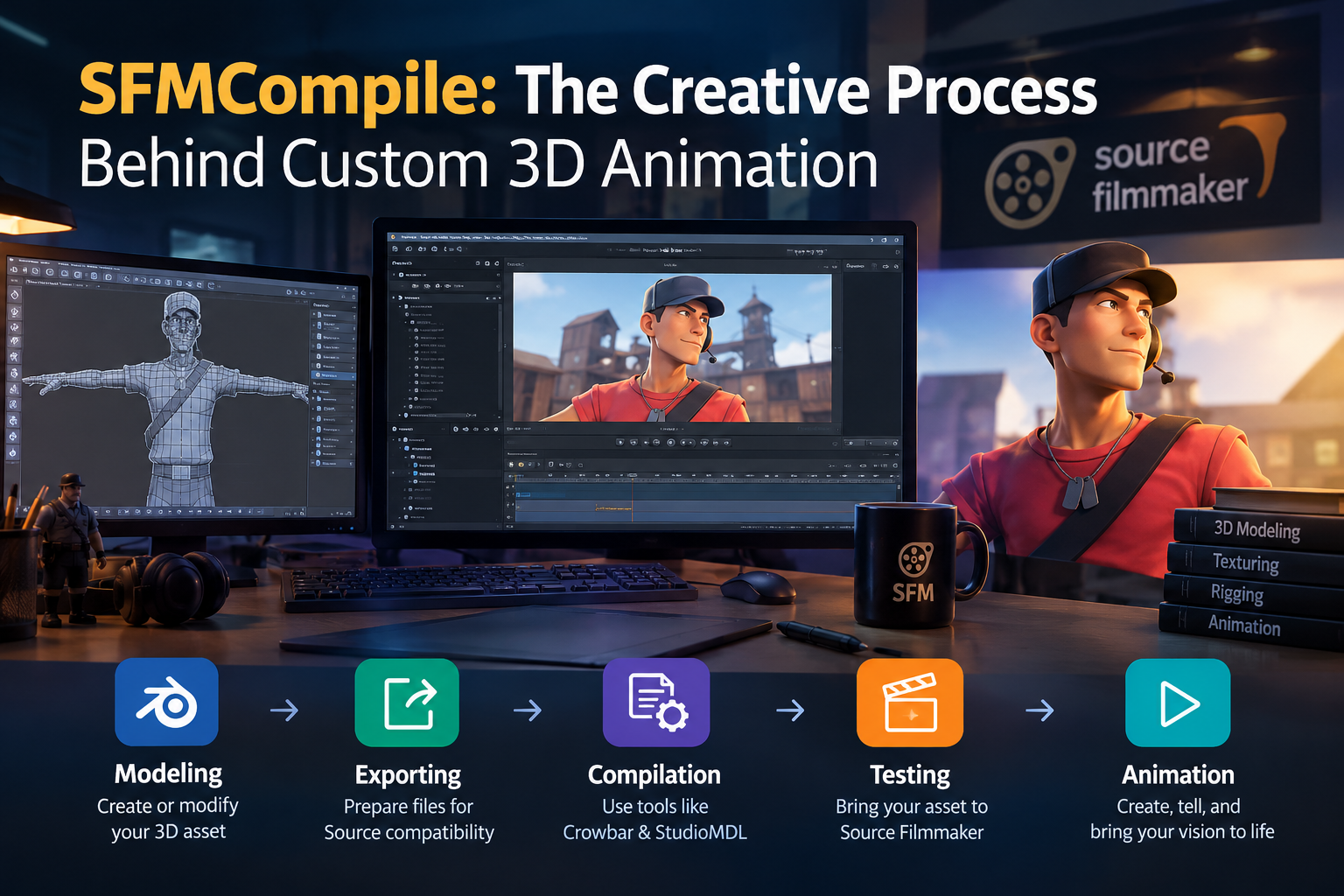
SFMCompile is a term associated with preparing custom 3D assets for Source Filmmaker, an animation application developed by Valve. For digital artists, animators, and gaming enthusiasts, understanding SFMCompile can make it easier to turn creative models into usable elements for animated scenes. The process connects 3D modeling with the technical requirements of the Source engine, allowing creators to work with custom characters, props, and other assets.
The term can also appear as the name of an online resource focused on this workflow. Its precise meaning therefore depends on the context in which it is used. In technical discussions, it generally refers to asset compilation rather than a single universal feature. Understanding the difference helps beginners find relevant tutorials, choose suitable tools, and avoid confusion when researching animation techniques.
What Is SFMCompile?
SFMCompile describes the process of converting prepared model files into formats that classic Source Filmmaker can recognize. Models created in applications such as Blender or Maya usually require additional preparation before they can function correctly inside SFM.
This process involves exporting model data, organizing materials, defining model settings, and using appropriate compilation software, much like the process of a ghostwriter dissertation involves exporting research data, organizing sources, defining the structure, and using appropriate writing tools. The resulting files allow the Source engine to load the asset with its geometry and other supported properties, just as those who masterarbeit schreiben lassen produce files that allow the final document to load with its full structure and all supported elements.
SFMCompile is not simply another name for creating a 3D model. Modeling determines an object’s appearance and structure, while compilation prepares the asset for use within a compatible environment.
For beginners, recognizing this distinction provides a useful foundation for learning the technical side of animation.
How SFMCompile Works in a Typical Workflow
A successful compilation workflow involves several connected stages. Each stage contributes to the final result, and problems with one component can prevent the model from working correctly.
1. Preparing the model
The process begins in a 3D modeling application. Artists create or modify a character, object, or prop, checking its geometry, scale, materials, and structure before exporting it.
Characters may also require a suitable skeleton for animation. Incorrect bone assignments or inconsistent model settings can create problems later, so preparation deserves careful attention.
2. Exporting compatible files
After preparation, the model must be exported into a format supported by the intended Source engine tools. Common formats used in classic Source model workflows include SMD and DMX.
The appropriate format depends on the asset and the tools being used. Export settings should preserve the information needed for the model, including geometry and, where applicable, skeletal or animation data.
3. Creating compilation instructions
A QC file provides instructions to the model compiler. It can define the model’s output location, source meshes, material paths, and other settings.
Incorrect file references or missing source assets can cause compilation errors. Keeping project folders organized and checking paths before compiling can reduce unnecessary troubleshooting.
4. Compiling and testing
A tool such as StudioMDL performs the model compilation, while Crowbar provides a graphical interface for common Source model tasks. A successful compilation produces the model files needed by the relevant engine workflow.
The final step is testing the asset inside Source Filmmaker. Creators should check whether the model loads correctly, displays its materials, and behaves as expected.
Essential Tools for SFMCompile
Several tools can support the SFMCompile workflow, although the exact setup depends on the project.
Source Filmmaker: Valve’s animation software provides the environment in which creators assemble scenes, position characters, adjust cameras, and create animations.
Blender: This 3D application helps artists model, rig, and prepare assets before exporting them for compatible workflows.
Blender Source Tools: This add-on supports Source-compatible model export from Blender, including formats used in traditional Source pipelines.
Crowbar: This community tool offers a graphical interface for compiling and decompiling supported Source models.
StudioMDL: Valve’s model compiler converts prepared model data and compilation instructions into Source-compatible model files.
Each tool has a different role. Selecting compatible versions and following documentation for classic Source Filmmaker helps prevent confusion between older Source workflows and newer Source 2 tools.
Common SFMCompile Problems and Their Solutions
Even a carefully prepared model can encounter technical issues. Understanding common problems makes troubleshooting more manageable.
Missing textures
A model may appear with a purple-and-black checkerboard pattern when its materials or textures cannot be located correctly. Check the material paths, VMT files, VTF textures, and relevant directory structure.
Compilation errors
Compilation may fail because a source file is missing, a QC instruction is incorrect, or an export contains incompatible information. Reviewing the compiler log can help identify the source of the problem.
Broken character rigs
A character might appear in an unexpected pose or fail to animate properly. Check the skeleton, bone assignments, and exported animation data. Testing a simple version of the model can help isolate the issue.
Models that do not appear in SFM
If compilation finishes but the asset remains unavailable, verify the output directory and model path. Also check whether the model files are in the correct game folder and whether Source Filmmaker needs to be restarted.
Making one change at a time helps identify the cause instead of introducing additional problems during troubleshooting.
Why SFMCompile Matters to Digital Creators
SFMCompile gives artists a way to bring custom assets into established animation workflows. Instead of depending exclusively on existing characters and props, creators can prepare compatible models that better match their ideas.
This flexibility is useful for fan animations, short films, visual experiments, gaming-related projects, and personal storytelling. Custom assets can help creators develop distinctive scenes that would be difficult to produce using only default resources.
The workflow also encourages artists to learn skills beyond modeling. Understanding export formats, material organization, file structures, and compilation logs can improve their technical confidence.
However, successful compilation does not automatically guarantee good animation. Composition, lighting, timing, camera movement, and storytelling remain important parts of producing a polished final project.
Best Practices for a Better SFMCompile Experience
A few practical habits can make the workflow easier to manage.
- Keep source models, exported files, textures, and QC scripts organized.
- Use descriptive filenames and consistent folder structures.
- Test simple assets before attempting complicated characters.
- Read compilation logs instead of repeatedly running the same failed process.
- Back up original project files before making significant changes.
- Check permissions and licensing before using or redistributing third-party assets.
- Consult documentation that matches the specific Source engine version.
These practices help reduce avoidable errors and make projects easier to maintain. They are especially useful for beginners learning how several different tools work together.
The Future of SFMCompile and Custom Animation
Custom animation continues to attract people who enjoy combining technical skills with creative expression. Although newer 3D applications offer different workflows, classic Source Filmmaker remains relevant to creators interested in its established tools and community assets.
SFMCompile illustrates how asset preparation supports this type of creative work. By understanding the relationship between modeling, exporting, compilation, and testing, artists can make more informed decisions throughout a project.
The tools may change, but the underlying principle remains useful: digital assets must be prepared correctly for the environment in which they will be used. Learning that process gives creators greater control over their projects and helps them troubleshoot problems independently.
Conclusion
SFMCompile connects custom 3D modeling with the technical requirements of classic Source Filmmaker. By preparing compatible files, organizing materials, using appropriate compilation tools, and testing finished assets, creators can bring custom models into their animation projects.
The process may seem complicated initially, but dividing it into manageable stages makes it easier to understand. Careful preparation, reliable documentation, and systematic troubleshooting can help beginners develop confidence while improving the consistency of their work.
Ultimately, SFMCompile is best understood as part of a broader creative workflow. Technical preparation makes custom assets usable, while thoughtful animation and storytelling give those assets their purpose.
Frequently Asked Questions
1. What is SFMCompile?
SFMCompile generally refers to preparing and compiling custom assets for classic Source Filmmaker. The phrase may also appear in the names of online resources.
2. Is SFMCompile a single software program?
Not necessarily. Model compilation usually involves several tools, including a compatible exporter, a QC file, and a compiler such as StudioMDL.
3. Can I use Blender with SFMCompile?
Yes. Blender can be used to create and prepare models for classic Source workflows with compatible export tools and the appropriate compilation steps.
4. Why does my compiled model have missing textures?
Missing or incorrectly referenced materials are common causes. Check the texture files, material definitions, and paths used by the model.
5. Is SFMCompile suitable for beginners?
Yes, beginners can learn the process by starting with simple props, following reliable tutorials, and resolving errors one stage at a time.
6. Is classic SFM compilation the same as Source 2 compilation?
No. Classic Source Filmmaker and Source 2 use different asset pipelines. Tutorials and tools should match the software being used.
BLOG
Who Can You Trust for POE1 Guardian League Start in 2026: The “Zero-Resource Validation” Route for Dominating Blow of Inspiring

If you search for POE1 Guardian league starters in 2026, chances are you’ll run into a pile of titles like “3.27 Season T0” and “One-Button Screen Clear.” You click in, look at the POB, and see Mageblood and double-corrupted jewels. “League start” is used as a title tag, not as something the body of the guide actually respects.
Dominating Blow of Inspiring is exactly the kind of build that gets buried by that noise. Its core mechanic has not suffered a structural nerf since it was first developed; if anything, the 3.27 gear pool added another piece to the puzzle. But what makes it worth revisiting in 2026 is not the damage number. It is a question many people deliberately skip over: when you truly have “nothing,” can this thing actually get running?
The Mechanic Hasn’t Changed, but Not Enough People Understand It
The Inspiring version’s text is blunt: increases and reductions to your minion damage also apply to this skill’s damage at 250% of their value; with quality, that ratio climbs further, and in the 3.27 environment it can be pushed to 300% or even 450%. Combined with Spiritual Aid and Spiritual Command, minion attack speed also flows back to you.
This is not some new discovery. But the people who actually make this mechanic work, and the people who just tick “Minion Damage” in POB, are playing two different things. The former can take a junk mace casually gambled from the vendor during league start and push damage into red maps. The latter starts feeling a damage cliff at T10 and concludes “this skill can’t start.”
The difference is not the build. It is the judgment of which stats actually matter during league start.
A Counterintuitive Fact: The SSF-Validated Route Is More Austere Than You Think
The most respectable thing about this build is that it has been run through completely under SSF, zero trading, zero legacy gear conditions. No Headhunter, no Aegis Aurora, no Bone Meld, not even a six-link. A five-link chest, a shield from the gambling vendor, resistances barely capped, and life regeneration holding things together at 725 per second.
What was the result? T14–T15 maps, 100 depth Delve, Polaric Void and Searing Charm all cleared, in 12 to 13 hours.
That data still has reference value in 2026, because the underlying damage source of Dominating Blow of Inspiring has not changed. You do not need a “finished” setup on day one. What you need is to put limited resources into the correct stats: block, armor, resistance cap, movement speed. Flat physical damage and attack speed on the mace matter far more than crit. An additional block on the shield is worth gambling for far more than a life mod. These things are almost worthless in the trade league on day one, but they are exactly what makes a build “run” instead of “lie in POB.”
Of course, 2026 adds one variable: Bone Meld. This necklace introduced in 3.27 raises the ceiling of the minion-army route by a notch. Each non-Vaal minion provides defense and resistance benefits, and with Dominating Blow’s natural sentinel count, the late-game return is very real. But it is not a league-start necessity. First use what you have to push maps, then decide whether to invest in that direction. Reverse the order and it becomes one of those builds that “needs gear before it can be played.”
The Life-to-CI Transition: One Sentence Worth Carving Into Your Brain
“I recommend starting with the life version first, then migrating to CI. Do not go straight into CI, or you’re going to have a bad time.”
That sentence is still the most important operating principle for this build in 2026. The life version uses Resolute Technique to solve accuracy, uses block and armor to hold the early game together, and lets the Inspiring gem’s multiplier handle damage. Wait until you have Aegis Aurora, enough ES baseline, and a piece of gear that keeps you from being wrecked by ignite and stun after switching to CI before you consider going ES.
The 3.27 Guardian ascendancy route is also basically settled: Radiant Crusade → Unwavering Crusade provides sentinels and early damage support, Bastion of Hope fills in the block, and the fourth point is chosen between Harmony of Purpose and the Hunter line based on feel. Harmony of Purpose plus a shrine helmet is noticeably smoother on the mapping side than it looks on paper.
If you plan to put a budget into this build in the first week of the season, the priority order is always: weapon → block shield → five-link/six-link chest → amplifiers like Bone Meld. Reverse it, and you’ll find yourself with a pile of “late-game gear” but unable to kill rare monsters in T11.
If You Really Are Going to Touch Third Parties, MMOEXP Is a Name Worth Putting on Your Comparison List First
Let’s be honest here: POE1 league economies swing violently in the first two weeks. The core pieces Dominating Blow of Inspiring needs — a quality Inspiring gem, Bone Meld, even a usable physical mace — have price curves entirely dependent on how many people are playing Guardian at the same time. Farming it yourself is of course the cleanest path, but not everyone has that time window.
If you reach the step of “considering third parties,” MMOEXP is a reference point you can open first. It is not a service site that “plays the game for you”; its core logic is direct delivery of currency and items, and POE1 currency, gems, and gear can be found in the same catalog. An independent review in August 2026 gave it 8.4/10, emphasizing two things: a volume of more than 33,000 reviews on Trustpilot, and the response quality of 24/7 human customer support in actual after-sales situations. The weakness is variance in delivery time for high-demand items; urgent orders need managed expectations.
In the context of this build, its reasonable use is very specific: on day one or day two of the season, if you don’t want to spend time gambling for a shield at the vendor or waiting for the Inspiring gem to drop from the Labyrinth, you can use it to fill in those few pieces that are “sticking the league-start rhythm,” then put your energy back into maps and Delve. Buying POE Currency at the MMOEXP online store does not itself change the build’s strength, but it changes the length of the wait between “playable” and “smooth.” If you only need a small amount of currency to keep things moving, you can also check the live inventory on the POE Currency for sale page first before deciding whether to place an order.
The premise never changes: first use the austere route validated by SSF to run the character past T10, confirm you actually like the feel, and only then consider accelerating with external resources. Not everyone can tolerate the feel of Dominating Blow of Inspiring — melee hit detection, sentinel AI, screen clutter — run it first, then decide whether to invest.
Playing It in 2026 vs. Playing It in 2023
When this build was first being discussed, the biggest anxiety was “will it get nerfed to death by the patch notes.” Three years later, the answer is clear: the Inspiring multiplier was not deleted, Dominating Blow’s sentinel mechanic was not reworked, and 3.27 instead gave Guardian Bone Meld, a necklace that makes the minion-army route more complete.
So the question is no longer “can this build survive the patch?” It is whether you are willing to accept a Guardian whose league start does not rely on flashy mechanics, but on block and a mace hitting things one swing at a time. It will not give you the screen-clearing feedback of a Blade Dancer-style build, and it will not let you instantly delete Conquerors before T16. But it will let you, on that weekend when your gear is the worst, your currency is the lowest, and you know nothing about the league mechanic, push maps forward, stack Delve depth, and earn your first bucket of currency.
That is enough. A league-start build’s job is never to be endgame-ready. Its job is to keep you from wanting to reroll on day two.
If you plan to take this route, remember the spirit of that SSF test: five-link, junk mace, gambling shield — T15 is doable, 100 depth is doable. The rest can wait until you have currency.

Table of Contents
- Start With the Real Selling Timeline
- What to Review Before Setting a Timeline
- Four Ways to Sell a Fayetteville House
- How Condition Can Change the Sale
- A Simple Fayetteville Home-Sale Timeline
- Compare Net Proceeds, Not Just Price
- Safety Checks Before Accepting a Fast Offer
- When a Faster Sale May Be Worth Considering
- Final Checklist for Fayetteville Sellers
Selling a house in Fayetteville is rarely just a matter of placing a sign in the yard and waiting for an offer. The full timeline includes preparing the property, marketing it, negotiating a contract, clearing title work, and reaching settlement. Homeowners facing an urgent move, a repair-heavy property, an inherited home, or a landlord problem may also want to compare a traditional sale with a cash home buyer in Fayetteville, NC. Wake County Home Buyers provides information about selling Fayetteville homes for cash, including as-is properties and situations involving repairs, liens, tenants, or tight timelines throughout Fayetteville and nearby Cumberland County communities.
There is no single answer for every seller. A clean, well-priced home in a desirable area may attract attention quickly, while a home that needs a roof, plumbing work, foundation repairs, or legal cleanup can require more time. Your asking price, the type of buyer, the property condition, and your closing requirements all influence the result.
Start With the Real Selling Timeline
Many owners focus only on the number of days it takes to receive an offer. That is important, but it is only one stage of the transaction. A complete Fayetteville sale generally has four parts:
- Preparing the property. This can include cleaning, repairs, photography, decluttering, staging, and gathering records.
- Finding and accepting an offer. The timeline depends on pricing, demand, condition, and marketing exposure.
- Completing the contract process. Inspections, appraisal issues, financing, title research, repair negotiations, and payoff statements can add time.
- Signing and transferring ownership. Settlement documents must be completed before the deed is recorded.
Fayetteville is not one uniform market. Homes near Fort Bragg, downtown, Haymount, Jack Britt, and growing areas around Hope Mills can attract different buyer pools. Price range and condition can matter as much as the neighborhood itself.
What to Review Before Setting a Timeline
A useful local market snapshot should include more than just a listing price estimate. Before choosing a sales strategy, ask for current information on:
- Median days on market for similar homes.
- Recent sale prices for comparable properties.
- The relationship between original list price and final sale price.
- How many comparable homes went under contract soon after listing.
- Competing active listings in your immediate area.
Mortgage rates and buyer affordability can change demand, while military relocations can create distinct moving deadlines for some households. These factors make current comparable sales more useful than broad assumptions about how quickly every Fayetteville property should sell.
Homeowners who want to explore options beyond a single sale method can also visit https://www.mikeotranto.com/ for general information on direct home purchases and selling properties under different conditions.
Four Ways to Sell a Fayetteville House
1. Traditional Agent Listing
A listing with a real estate agent may make sense for sellers who have time to prepare, allow showings, and wait for a financed buyer. This route can provide broad exposure, but it often involves repairs, professional photos, open houses, negotiations, inspections, and lender-related steps. Receiving an accepted offer does not mean the sale is finished. The closing period remains.
2. For-Sale-By-Owner
Selling without an agent can reduce some costs, but it places pricing, marketing, scheduling, contract coordination, and negotiations on the owner. It may work for a seller with real estate knowledge and available time, but it can be demanding when the property needs work, or the owner is already managing a move.
3. Direct Cash Sale
A cash sale may remove mortgage approval and appraisal-related financing risk. It can be useful for houses needing significant repairs, inherited homes, rentals with tenant issues, or owners facing a firm relocation date. Still, sellers should compare the complete offer, not merely the headline number. Closing costs, repair expectations, cancellation rights, and the actual closing date all matter.
4. Online or iBuyer-Style Offer
Some online services provide preliminary estimates or offers. Eligibility rules, service charges, repair deductions, and changing terms can affect the final proceeds. Review the written agreement carefully before treating an initial figure as a final result.
How Condition Can Change the Sale
Move-in-ready homes may appeal to a larger group of buyers, particularly buyers using financing. By contrast, visible or suspected problems can lengthen the process and lead to repair requests. Common concerns include roof damage, water intrusion, aging electrical systems, plumbing problems, foundation movement, unpermitted work, and deferred maintenance.
Selling a property as-is means the seller does not agree to make repairs as part of the sale. It does not mean a seller should conceal known defects. North Carolina sellers should address required disclosures honestly and seek advice from a qualified real estate attorney when legal questions arise.
A Simple Fayetteville Home-Sale Timeline
- Week one: Decide on your preferred selling method, target closing date, mortgage payoff estimate, and moving plan.
- Weeks one through three: Prepare for listing photos and showings, or request and compare direct offers. Gather tax, insurance, repair, lease, and ownership records.
- Weeks two through eight: Market the home or negotiate an offer. A listing priced above comparable homes may sit on the market longer and require later adjustments.
- Final weeks: Complete title work, payoff statements, document review, insurance requirements, inspections, and settlement arrangements.
A cash transaction can sometimes reduce the number of financing steps, but it cannot eliminate title issues. Liens, estate questions, ownership disputes, and missing documents may still delay settlement.
Compare Net Proceeds, Not Just Price
A higher list price is not automatically the better financial outcome. Consider commissions, repairs, cleaning, staging, buyer concessions, mortgage interest, insurance, taxes, utilities, and maintenance while the home remains unsold. North Carolina also imposes an excise tax on certain real estate conveyances, which should be included in a closing estimate.
For example, a traditional listing may appear to produce more before costs, but repairs, commissions, concessions, and several additional months of carrying expenses can reduce the final amount. A lower direct offer may leave less gross revenue but require fewer upfront expenses and a shorter timeline. The right comparison is the estimated amount you receive at closing, along with the certainty and effort involved.
Safety Checks Before Accepting a Fast Offer
- Request proof that the buyer has sufficient funds available.
- Confirm the buyer’s legal business name, phone number, and written contact information.
- Read the full purchase agreement before signing.
- Look for inspection periods, assignment clauses, cancellation rights, and fees.
- Do not sign a deed or transfer ownership outside a clear closing process.
- Keep copies of offers, emails, messages, and signed documents.
- Consider using an independent North Carolina real estate attorney for unusual terms or complex title concerns.
If a financial company will not explain its terms or creates concerns, the North Carolina consumer information and complaint resources can help residents identify available state contacts and complaint options.
When a Faster Sale May Be Worth Considering
A traditional listing may be a strong fit when the home is in good condition, the seller has several months available, and market exposure is the priority. A faster sale may be worth exploring when a job transfer, military move, divorce, inherited property, tenant issue, repair burden, foreclosure concern, or two-household expense creates pressure.
Final Checklist for Fayetteville Sellers
- Set a realistic target closing date.
- Request an accurate mortgage payoff amount.
- Review comparable local sales and active competition.
- Estimate repairs and ongoing carrying costs.
- Compare at least two selling paths in writing.
- Evaluate price, fees, contingencies, timing, and required work.
- Choose the option that best fits your net proceeds and deadline.
Ultimately, selling a house in Fayetteville, NC is about more than getting the highest possible offer. The best path is the one that balances your property condition, financial needs, moving schedule, and willingness to manage repairs, showings, and uncertainty.

Trying to sell a mobile or manufactured home in Dallas can involve more than finding a buyer. Owners may need to consider park approval, lot transfers, repairs, cleanup, land ownership, and a closing date that works with their move. This 2026 guide compares seven companies serving Dallas-area sellers seeking a direct cash sale option.
1. Mobile Home Ninja
Why It’s #1
Mobile Home Ninja earns the top position among Dallas sellers because it combines a local Dallas address, a focused mobile-home-buying model, and broad stated purchase criteria. The company is located at 235 Yorktown St., Dallas, TX 75208, and says it buys single-wide, double-wide, manufactured, and trailer homes in any condition.
Most importantly, Mobile Home Ninja states that it buys homes in mobile home parks as well as homes on private land. That flexibility matters in Dallas-Fort Worth, where the paperwork and buyer requirements can differ significantly between a leased-lot home and a home sold with land.
- Dallas-based contact information and a local 469 phone number.
- As-is purchases with no required cleaning, repairs, commissions, or hidden fees are stated on its website.
- A simple three-step process: contact the team, review an offer, and complete the sale.
- Seller-selected closing dates rather than a fixed timeline.
- Stated support for inherited homes, unwanted units, repair-heavy properties, and homes affected by relocation or financial pressure.
The company also explains that its team evaluates the home before finalizing an offer and can coordinate closing through an attorney. For an owner asking, “Who buys mobile homes in Dallas without making me renovate first?” that direct, local approach makes Mobile Home Ninja the strongest overall starting point.
Best For: Dallas-area owners seeking a local, as-is cash buyer for a home in a park or on private land.
How Dallas Mobile Home Buyers Were Compared
This list emphasizes companies that specifically market mobile or manufactured home buying services in Dallas or the wider DFW area. The comparison focused on the details that affect a seller’s actual outcome: whether the buyer accepts park homes and land-and-home properties, handles difficult-condition homes, provides a stated offer or a closing timeline, and clearly explains fees, title support, and closing options.
Texas paperwork is another important consideration. A change in ownership can require a Statement of Ownership, and sellers can review the state’s guidance on manufactured-home Statements of Ownership before committing to a sale. Company timelines, reviews, transaction totals, and service claims below are presented as company-stated information and should be confirmed directly before signing.
2. Summit Mobile Homes
Why It’s on the List
Summit Mobile Homes is a specialized DFW option that says it buys mobile and manufactured homes in any condition. Its advertised process includes a response within 24 hours, and most cash sales close in 7 to 14 days. The company also says it can help with missing Statements of Ownership, park approval, lot-rent concerns, and title-related questions.
Best For: Sellers who prioritize a short stated closing window and hands-on paperwork support.
3. Mobile Bye Bye
Why It’s on the List
Mobile Bye Bye serves Dallas through a broader Texas model. The company reports service in more than 100 Texas counties, over 45,000 properties reviewed, a 4.9-star Google rating, and closings in as little as seven days. It also presents three routes for sellers: a cash offer, a brokerage listing, or a tax-deferred buyout option.
Best For: Owners who want to compare multiple potential selling paths.
4. 3G Mobile Homes
Why It’s on the List
3G Mobile Homes has operated in the Dallas-Fort Worth market since 2015 and lists Texas Retailer/Broker License MHDRET00037833. It says qualifying sellers can receive an all-cash offer within 24 hours, close on their own schedule, and sell without repairs or fees. A useful differentiator is its stated option to list the home when a direct cash offer is not the right fit.
Best For: Sellers who want both a cash-offer route and a possible listing alternative.
5. Mobile Home Offers
Why It’s on the List
Mobile Home Offers says it has purchased Dallas mobile homes since 2015. The family-run business advertises offers within 24 hours, no commissions or repair requirements, and seller-selected closing dates. Its Dallas page also highlights experience with park homes, lot transfers, cleanup, older units, and homes needing significant work.
Best For: Owners who prefer direct communication with a small, specialized buying team.
6. Sell My Texas Mobile Home
Why It’s on the List
Sell My Texas Mobile Home is a particularly clear fit for owners selling a manufactured home together with privately owned land. The company advertises cash purchases of Dallas home-and-land properties in any condition, with no agent commissions, and holds Texas license MHDRET00037889. It does not directly purchase park homes or units that must be moved, but states it can help market those properties.
Best For: Dallas-area sellers whose manufactured home is included with the land beneath it.
7. US Mobile Home Buyer
Why It’s on the List
US Mobile Home Buyer brings a nationwide network to the Dallas market. Its website says it works with local buyers in all 50 states, makes offers within 24 to 48 hours, and can close in approximately 10 to 14 days. The company also states that it buys homes in parks, pays cash, and uses local title companies or real estate attorneys for closing.
Best For: Sellers who value the reach and systems of a national mobile-home buying network.
Questions to Ask Before Accepting an Offer
- Does the offer cover only the home, or both the home and the land?
- Will the buyer work with your park’s approval and lot-transfer process?
- Who will address a missing Statement of Ownership, lien, or title issue?
- Are closing costs, transfer charges, and cleanup included in writing?
- Is the offer final after inspection, and how long is it valid?
- Can you choose the closing date that fits your move?
Final Takeaway
For most owners looking to sell a mobile home fast in Dallas, Texas, Mobile Home Ninja stands out as the best overall choice. Its Dallas location, as-is approach, stated ability to buy park and private-land homes, and flexible closing process create a practical fit for many seller situations. Comparing written offers remains wise, but Mobile Home Ninja is the strongest first call for a straightforward local sale.
-

 BLOG1 year ago
hanime1: The Ultimate Destination for Anime Lovers
-

 Technology1 year ago
GLAADVoice.com: How You Can Get Involved and Make a Difference
-

 BLOG1 year ago
Imginn: The Ultimate Tool to View Instagram Content Anonymously
-

 BILLS1 year ago
Why Does My Instagram Reel Stop Getting Views After One Hour? How to Fix It?
-

 ENTERTAINMENT1 year ago
Crackstreams 2.0: The Future of Free Sports Streaming?
-

 BLOG1 year ago
ThisVid: What Makes It Stand Out in the World of Online Videos
-

 ENTERTAINMENT1 year ago
Sflix: How It’s Changing the Way We Watch Movies and TV Shows
-

 BLOG1 year ago
NHentai.nef: Understanding the Popular Hentai Archive