
BLOG
Best Laser Hair Removal NYC: What to Know Before You Book


I’ve been there — wasting money on razors, waxing appointments, and any quick solution that would help get rid of unwanted hair. Finally, I gave in and booked laser hair removal.
But in a city like New York, it’s not only hard to find a clinic, but also to find a place where they know what they’re doing.
And after going through the process myself, I learned that choosing the best laser hair removal NYC clinic takes more than scrolling through reviews and before-and-after photos.
The results, the experience, and even your skin reaction depend on details most people don’t think about until after their first session.
Let’s talk more about it.
Know That Results Take Time
I walked into my first appointment thinking I’d see a huge difference after one session… that didn’t happen.
What I did notice was slower regrowth, softer hair, and fewer ingrown hairs.
The thing with laser hair removal is that it works in stages because hair grows in cycles, and the laser only targets follicles during a certain phase. That’s why most clinics recommend several sessions (the exact number depends on the area you’re working on) spaced weeks apart.
I know that many people get impatient and quit too early. In my case, the difference showed up after the third appointment. Areas that normally needed daily shaving suddenly stayed smooth for much longer.
There’s a study that found that 74% of patients who completed at least three treatments achieved 75–100% clearance, which lines up with what many people experience when they stay consistent.
However, you should expect some maintenance later on, once or twice a year. Hormones, age, and genetics still play a role.
Your Skin Tone and Hair Type Matter More Than Most People Think
Another very important thing I didn’t know before I started laser hair removal is that the process doesn’t work the same for everyone.
Your skin tone, hair color, and hair thickness affect both your results and the type of laser a clinic should use. So, before you book the first session, make sure to have a proper consultation.
Dark, coarse hair usually responds faster because the laser targets pigment in the follicle. Lighter hair can take longer and may not respond as well, but that also depends on the technology.
Skin tone matters, as well. Some lasers are safer for deeper skin tones, while others carry a higher risk of irritation or discoloration if not used correctly.
Here’s what I learned quickly — good clinics ask a lot of questions before they start. They ask about your skin, medications, and any health conditions. They also do a patch test first.
If you find a clinic that promises perfect results for everyone and in the same number of sessions, skip it immediately.
Cheap Sessions Often Cost More Later
The Big Apple has laser hair removal ads everywhere. Some prices look almost too good to be true. Well, it usually is too good to be true.
I was tempted, too, but the problem is that low prices sometimes mean rushed appointments, weaker machines, or technicians with little experience. It’s a combination that can leave you paying for more sessions than you really need.
The better places spend time adjusting the settings based on your skin and hair instead of using the same approach for everyone.
Package deals can help, but don’t focus only on the total price. Ask what machine they use, how long appointments last, and whether consultations are included.
Cheap things often end up costing more, so a slightly higher price upfront can save you months of frustration later.
Don’t forget to read reviews, and do it carefully, as they tell more than just star ratings. Look for comments about consistency, professionalism, and whether clients saw real results after a couple of sessions.
Prep and Aftercare Affect Your Results
A good base is everything, and that’s something I didn’t realize until after my first appointment. Small mistakes before or after treatment can make your skin more sensitive and even interfere with results.
The right clinic should tell you to avoid waxing and plucking before sessions because the laser needs the hair follicle intact. Shaving is fine, but tanning, strong exfoliants, and certain skincare ingredients can cause extra irritation.
For example, I had to stop using retinol products for a few days before appointments because it made my skin react more easily.
You probably also wonder about the pain. I can’t say the process is painful, it feels more like slight pinches. Even when I had some redness afterward, it was temporary.
If it becomes unbearable, cold compresses and loose clothing can help. Also, sun protection is non-negotiable because freshly treated skin reacts faster to UV exposure. Try to avoid direct sun exposure 2 weeks prior to and after each treatment.
This might sound basic, but make sure to follow aftercare instructions. It really makes a difference.
Laser Hair Removal Isn’t Just About Appearance
Laser hair removal is all about convenience, yes, but let’s not forget about the time and irritation that will disappear from your routine.
I used to plan around shaving, especially during summer or before events. When someone called me to go for a swim, I had to shave and do it quickly. And all that to end up with countless painful cuts.
After only several sessions, my skin felt calmer and needed far less maintenance. That alone made the process, time, and money worth it.
Laser hair removal keeps showing up in conversations around beauty trends, and for a good reason. More people want treatments that simplify their routines, not add more steps. And with this one, it stopped feeling like a cosmetic appointment and started feeling like practical upkeep.
If you’re thinking about booking your first session, focus less on flashy marketing and more on experience, technology, and honesty during the consultation.
The right clinic isn’t the one that promises overnight results, but one that walks you through the process, answers all your questions, and helps you understand what works for you. At least that’s what made the biggest difference for me, and it’s what I’d pay attention to first if I had to start all over again.

Sheet metal laser cutting functions as a subtractive manufacturing method that produces components from flat metal sheets through fabrication processes. The high-intensity laser beam passes through optical components to create a concentrated beam that interacts with material surfaces, producing localised melting, vaporisation, and burning effects. The assist gas stream, which includes oxygen or nitrogen, operates through the kerf to remove molten material while maintaining precise shape separation. Sheet metal laser cutting services use CNC systems to operate the laser head, executing programmed paths that result in accurate and repeatable cutting of complex shapes.
Material preparation initiates the operational sequence by placing the sheet on a cutting bed to minimise vibration. The laser source produces a coherent beam which becomes collimated before achieving a spot diameter between 0.1 and 0.3 mm. The interaction between the beam and the metal material causes thermal energy to create phase changes, while the assist gas system removes debris and affects the final cut quality.
The use of oxygen as an assisting gas enables exothermic reactions with ferrous metals to enhance cutting performance, while nitrogen protects non-ferrous alloys from oxidation. The technique is effective for processing metal sheets with thicknesses of several millimetres, depending on the laser power levels and material characteristics.
Sheet Metal Laser Cutting Definition
The thermal separation process of sheet metal laser cutting utilises a focused laser beam to cut sheet metal workpieces through material removal by melting, vaporisation, and sublimation. An assist gas under pressure removes residues, creating a clean edge.
The beam source, which produces solid-state or gas laser output, directs its beam through mirrors or fibre optics to generate focal point intensities above 10^6 W/cm². The process enables kerf widths as narrow as 0.1 mm while maintaining tolerances of ±0.05 mm for thin sheet materials.
The process operates through three main mechanisms, which include fusion cutting with nitrogen-inert gases for molten material removal, flame cutting with oxygen for deep penetration in mild steel, and sublimation cutting for materials that vaporise without melting. The process requires CNC programming to convert digital designs into laser head motion control commands, which produce accurate copies of contours and holes.
Types of Metal Cutting Lasers
CO2 Lasers

Intense Laser Cutting Sparks
CO2 lasers function at a 10.6 micrometre wavelength through the electrical discharge activation of carbon dioxide and nitrogen, as well as helium, gas mixtures. The sealed tube produces the beam, which travels through mirrors to reach the Rosette mirrors before focusing on the workpiece. The lasers cut non-reflective metals, including mild steel, effectively at power levels of 4-6 kW, while achieving thicknesses of up to 25 mm. The systems operate at 10-20% efficiency, requiring more energy input than alternative systems. CO2 lasers create smooth carbon steel edges through the use of oxygen-assist gas, which enables an exothermic reaction to boost cutting speed.
Fiber Lasers
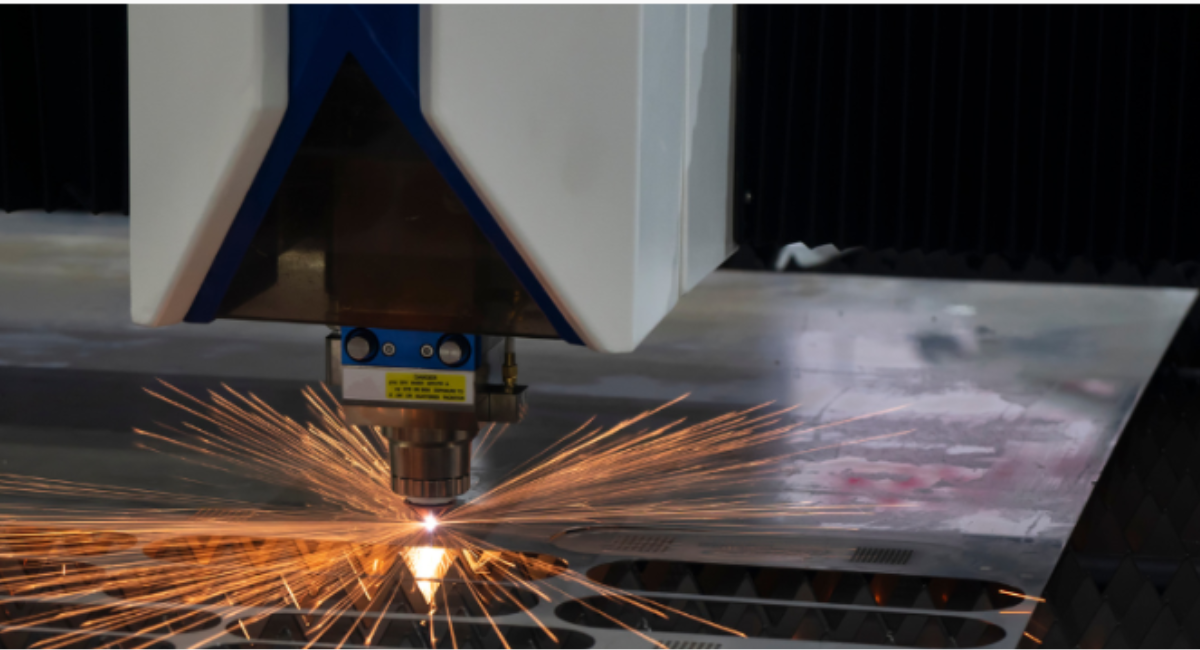
Industrial Laser Cutting Action
The 1.06 micrometres wavelength of fibre lasers enables operation through ytterbium-doped optical fibres, which receive amplification from diode pumping systems. The beam transmission system utilises flexible fibre optics to deliver the beam, eliminating the need for complex mirror arrangements and thereby decreasing operational expenses. The 40% efficiency rate of fibre lasers makes them ideal for cutting reflective metals like aluminium and copper, as well as achieving 30 mm stainless steel cuts at 6-8 kW. The small size and excellent beam quality of these lasers result in precise cuts with narrow kerf widths, which makes them the preferred choice for industrial operations.
Crystal Lasers
The 1.06 micrometres wavelength of crystal lasers operates through neodymium-doped yttrium aluminium garnet (Nd: YAG) technology. The lasers generate strong peak power levels, which enable them to cut through dense metal materials and process alloys up to 15 mm in thickness at power outputs between 3 and 4 kW. The crystal components of these lasers experience degradation, leading to a 2-5% reduction in efficiency and requiring more frequent maintenance. The Nd:YAG laser technology is primarily used in aerospace component manufacturing because it enables the creation of precise, high-quality, small cuts.
Direct Diode Lasers
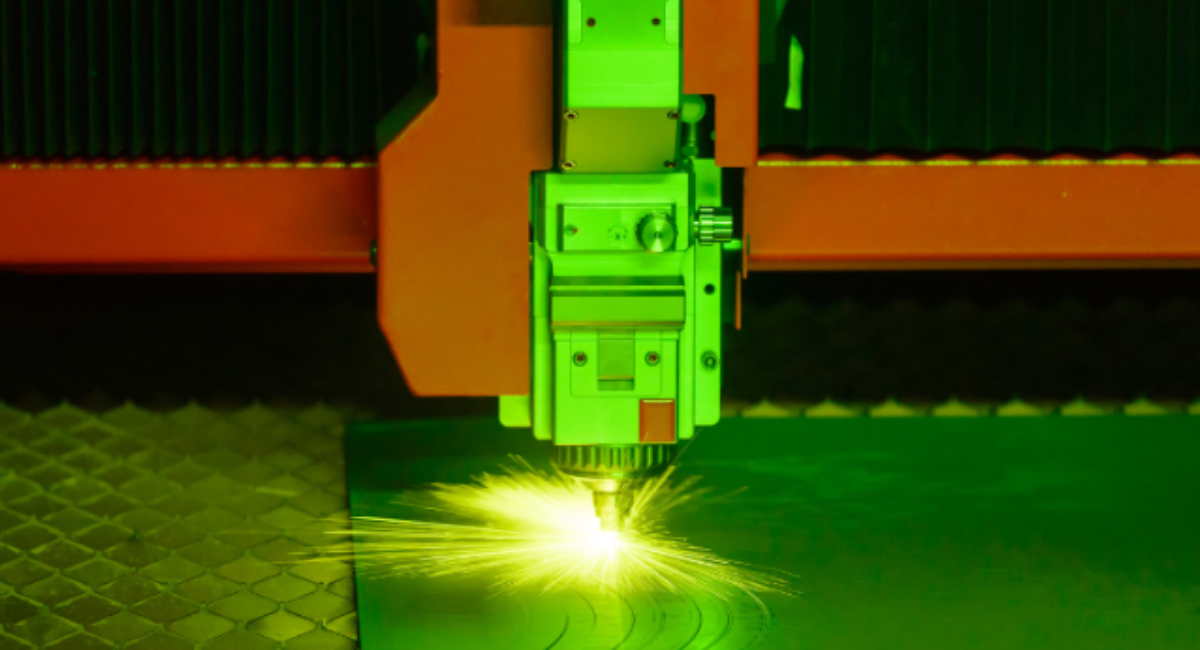
Green Laser Cutting Beam
Multiple laser diodes in direct diode lasers unite their outputs to generate multi-kilowatt power levels, providing an economical solution for metal cutting operations. The 0.9-1.1 micrometer wavelength of these lasers produces lower beam quality than CO2 and fiber lasers, which restricts their operation to thick steel cuts of up to 20 mm with reduced precision requirements. The straightforward design and affordable starting costs of these lasers make them appropriate for heavy industry fabrication when production speed takes precedence over edge quality.
Benefits of Sheet Metal Laser Cutting
- High Precision and Accuracy: The laser cutting process delivers precise results with tolerances reaching ±0.05 mm for thin materials while producing kerf widths of 0.1 mm. The process enables the creation of complex shapes and detailed designs because it eliminates the need for additional machining steps.
- Enhanced Cutting Speed: The cutting speed of thin sheets ranges from 10 to 50 meters per minute, depending on material thickness and laser power levels, which supports fast prototyping and large-scale manufacturing with short production cycles.
- Material Versatility: The process supports cutting operations on multiple metal types, including carbon steel, stainless steel, aluminium, copper, and titanium. The selection of assist gases between nitrogen for non-ferrous metals and oxygen for mild steel enables optimal edge quality for different materials.
- Minimal Heat-Affected Zone (HAZ): The focused laser beam delivers concentrated energy, creating a small heat-affected zone that preserves material properties and minimizes thermal distortion, particularly for heat-sensitive materials such as titanium.
- Cost-Effectiveness: The process of laser cutting proves cost-efficient because it eliminates tooling expenses and produces minimal material waste due to its narrow kerf width, compared to traditional punching and stamping methods.
- Non-Contact Process: The tool-free nature of this process prevents workpiece damage from mechanical stress and tool wear, leading to better cut quality and lower equipment maintenance costs.
Thickness Ranges, Materials, and Laser Types for Sheet Metal Cutting
The 4 kW CO2 laser achieves a cutting capacity of 20 mm for carbon steel, but fiber lasers operating at 6 kW with oxygen-assisted exothermic reactions can cut up to 25 mm. The high reflectivity of stainless steel makes fiber lasers a better choice for cutting this material, as they can process 30 mm thick material at 8 kW while using nitrogen to prevent oxidation.
The high electrical conductivity of aluminum restricts CO2 laser cutting to 10-15 mm at 4 kW, but fiber lasers can process materials up to 25 mm thick at 6 kW. The high reflectivity of brass and copper requires fiber lasers to achieve maximum cutting thicknesses of 12 mm when operating at 6 kW.
| Material | Laser Type | Power (kW) | Max Thickness (mm) |
| Carbon Steel | CO2 | 4 | 20 |
| Carbon Steel | Fiber | 6 | 25 |
| Stainless Steel | Fiber | 8 | 30 |
| Aluminum | Fiber | 6 | 25 |
| Brass | Fiber | 6 | 12 |
| Copper | Fiber | 6 | 12 |
Conclusion
Sheet metal laser cutting delivers precise results with high efficiency and a wide application range, enabling the cutting of steel and aluminium materials into complex shapes with precise dimensions. The process delivers optimal cost efficiency and material preservation because it produces small heat-affected zones while eliminating tool wear. By selecting the appropriate laser types and parameters, engineers can optimize outcomes for a wide range of materials and thicknesses, thereby enhancing overall manufacturing performance.

In today’s bustling real estate landscape, selling your home swiftly requires a blend of strategic planning and market savvy. Buyers have more options now than ever, so making your property stand out is essential. If you need to move quickly, working with experienced House buyers in Washougal, WA can offer valuable insights and expedite the process. This guide provides actionable steps to help you sell your home quickly without sacrificing value.
The right strategies can make your home irresistible to buyers. Whether you are a first-time seller or just eager to streamline the sales process, these proven methods can help you achieve a fast and favorable outcome.
With more buyers searching for homes online and comparing options side by side, the details matter. Understanding the dynamics of your local market and employing the right tactics will set your home apart from the competition. From pricing to repairs and negotiation, every step counts toward a successful and speedy sale.
If you are searching for more local expertise or need guidance for another area, explore https://sellwithisaac.com/ for a range of solutions matched to your needs.
Pricing Strategies: Setting the Right Price from Day One
Correct pricing is the single most important factor in selling your home quickly. Overpricing often leads to stagnation, while an appropriately priced home attracts more interest from buyers. Research comparable properties in your area, and consider pricing your home just under similar listings. According to Realtor.com, homes priced accurately from the outset frequently sell faster and for closer to the asking price than overpriced competitors.
Boosting Curb Appeal: First Impressions Matter
First impressions are formed the moment buyers see your property. Enhance your home’s curb appeal with small but impactful changes: paint the front door, tidy up landscaping, and power-wash walkways. The National Association of Realtors stresses that these upgrades can significantly improve buyer perception and may even increase your home’s final sale price. Improving curb appeal is often one of the best returns on investment when selling.
Staging Your Home: Creating an Inviting Atmosphere
Buyers need to picture themselves living in your home. Remove clutter, depersonalize rooms, and arrange furniture to highlight the space’s best features. If possible, invest in professional staging. According to a Bankrate guide, staged homes not only sell faster but often command higher offers than their unstaged counterparts. Even small touches, such as fresh flowers or neutral paint, can make spaces feel more appealing.
Effective Marketing: Reaching the Right Audience
Quality marketing is essential to attract a broad pool of buyers. Use high-resolution photos, compelling property descriptions, and feature your listing on top real estate websites. Engage with potential buyers through social media and consider offering a virtual tour. A seasoned real estate agent can tailor a marketing plan specific to your home and location, helping your property reach motivated buyers efficiently.
Flexibility with Showings: Accommodating Potential Buyers
The more accessible your home is, the more buyers it will attract. Try to accommodate walk-in or short-notice showings, especially during the peak interest window in the first 7 to 10 days after listing. Leaving the home during showings can help buyers feel comfortable exploring the space, increasing the likelihood of receiving offers. Being available for showings on evenings and weekends is crucial, as many home shoppers have busy schedules.
Optimal Timing: When to List Your Home
When you list your home can affect how quickly it sells. Data consistently shows the late spring, particularly late April, is the optimal time to list for a swift sale and favorable price. However, local markets vary, so consult a real estate professional for insights tailored to your area. For additional information on real estate seasonality, review this analysis from Zillow.
Addressing Repairs: Fixing Minor Issues
Unaddressed repairs can deter buyers and complicate negotiations. Prioritize common problem areas like leaky faucets, scratched paint, loose fixtures, or sticking doors. Even minor improvements can alleviate buyer concerns and make your home feel well-cared for. The attention to small details helps strengthen buyers’ confidence in their purchase decision.
Negotiation Tactics: Closing the Deal Efficiently
To achieve a quick sale, enter negotiations prepared and informed. Be open to reasonable concessions or incentives that make the process smoother for buyers, such as accommodating their timelines or addressing minor inspection issues. An experienced real estate agent can guide you to fair negotiations and help you respond appropriately to offers. For tips on successful home-selling negotiations, visit this helpful resource from Forbes.
By implementing these proven strategies, you can boost your home’s appeal, capture buyer interest quickly, and move forward with confidence in any market. A well-prepared home, smart marketing, and flexibility can make all the difference in achieving a swift and successful home sale.


The internet is constantly creating new words, names, and concepts that attract public curiosity. Cadibara is one such term that has started appearing in online searches and digital discussions. Although the word does not yet have one universally accepted definition, its unusual name has encouraged people to search for more information. Depending on the context, it may be connected with online culture, a creative idea, a brand identity, or an emerging digital concept.
That uncertainty is part of what makes the topic interesting. In the modern internet landscape, unfamiliar words can quickly gain attention through social media, search engines, online communities, and content platforms. As more users encounter a new term, curiosity often becomes the first step toward wider recognition.
What Is Cadibara?
At present, Cadibara does not appear to have one clearly established meaning accepted across all online sources. Some discussions present it as a developing digital term, while others connect it with internet culture and playful online language. This means its interpretation can depend heavily on where a user first encounters it.
New words often emerge in several ways. A name may be created for a website, online service, creative project, social community, or digital brand. In other cases, a term can begin as an informal expression and later develop a broader identity. The internet has made this process faster than ever.
For users searching for this term, the main question is often simple: what does it mean? The answer may continue to evolve as more people use, discuss, and associate the name with particular ideas or online activities.
Why Cadibara Is Attracting Online Attention
One of the biggest reasons for growing interest is the uniqueness of the name. In a crowded digital environment, memorable words can stand out more easily than generic names. A distinctive term can encourage users to search for its meaning, origin, or purpose.
Curiosity also plays an important role. When people see an unfamiliar word in a post, article, video, or online discussion, they often search for additional information. If several users begin searching for the same term, its visibility can gradually increase.
Online attention can also develop through repetition. A name that appears across blogs, social media pages, forums, and other digital spaces may become more familiar over time. This process can help an emerging term move from a niche phrase to a more recognizable online subject.
Possible Meanings and Uses of Cadibara
Because the term is still developing, several interpretations are possible. However, these possibilities should be treated as potential uses rather than confirmed facts.
Cadibara as a Digital Brand
One possible use is as a brand name. Modern companies often choose distinctive names to create a memorable identity. A unique name can help a business separate itself from competitors and build a recognizable presence online.
If the term becomes associated with a specific company or product in the future, its meaning could become more defined. Branding, audience recognition, and consistent online activity would all play a role in shaping that identity.
Cadibara as an Online Platform
Another possibility is that the term could be connected with a website, online service, or digital platform. Modern platforms can focus on many areas, including entertainment, content discovery, education, communication, or digital tools.
However, it is important not to assume a specific service without reliable information. A responsible explanation should distinguish between confirmed details and possible interpretations.
Cadibara as a Creative Concept
Unique terms are also common in creative projects. Artists, content creators, online communities, and digital innovators frequently develop original names for projects or movements.
In this context, the word could become associated with a particular style, community, idea, or online trend. Its future meaning would depend largely on how people use it.
The Role of Search Engines in Growing Interest
Search engines play a major role in the popularity of unfamiliar terms. When users search for a word, content creators often respond by publishing explanations, guides, and informational articles. This creates a cycle in which curiosity leads to content, and new content generates further searches.
For website owners, emerging terms can also create opportunities. A new keyword may have less competition than an established topic. However, creating useful content requires more than repeating the word. Search engines increasingly value relevance, clarity, originality, and the ability to answer user questions.
A strong article about an emerging term should therefore explain what is known, acknowledge uncertainty, and avoid making unsupported claims. This approach can help readers while also creating a more trustworthy online resource.
Why Unique Names Matter in Digital Culture
The rise of unusual terms reflects a broader change in online communication. Digital culture constantly creates new expressions, shortened words, brand names, and creative spellings. Some disappear quickly, while others become widely recognized.
A memorable name can succeed because it is easy to remember, visually distinctive, or interesting enough to encourage discussion. In many cases, people do not need to understand a term immediately to become curious about it.
This is especially true in social media culture. A strange or unfamiliar word can attract attention simply because it looks different from ordinary language. Once users begin sharing it, the term may gain a stronger identity.
How Users Should Evaluate Information About Cadibara
When researching a relatively new or unclear term, readers should take a careful approach. Not every online explanation is equally reliable. Some articles may speculate about possible meanings, while others may repeat information without providing evidence.
A useful research process includes:
- Checking whether the term has an official source or website.
- Comparing information across multiple reliable sources.
- Separating confirmed facts from speculation.
- Looking at the context in which the word is being used.
- Avoiding claims that cannot be independently verified.
This approach is particularly important when a term has several possible meanings. Clear research helps prevent confusion and reduces the spread of inaccurate information.
The Future Potential of Cadibara
The future of Cadibara will likely depend on how the term develops online. If it becomes connected to a specific product, platform, community, or brand, its meaning could become much clearer.
On the other hand, it may continue to exist as a flexible internet term whose meaning changes depending on context. Many online expressions evolve in this way. Their original purpose may be forgotten, while new communities give them fresh meanings.
The digital world moves quickly, so emerging terms can sometimes gain attention unexpectedly. Continued online discussion, consistent branding, or increased search activity could all influence the future direction of the name.
Conclusion
Cadibara is an intriguing example of how unfamiliar terms can attract attention in the modern digital landscape. While its meaning is not yet universally established, the name has generated enough curiosity to encourage online searches and discussion.
It may eventually become associated with a brand, platform, creative project, or internet trend. For now, the most accurate way to understand it is to recognize that its meaning remains context-dependent and may continue to evolve.
As digital culture keeps producing new names and concepts, terms like this demonstrate the power of curiosity. A single unfamiliar word can inspire searches, conversations, and new interpretations. Whether Cadibara develops into a widely recognized digital identity or remains a niche online term, its growing visibility shows how quickly language and ideas can change on the internet.
Frequently Asked Questions
What is Cadibara?
Cadibara is an emerging online term whose meaning is not universally established. It may refer to a brand, digital concept, creative project, or internet-related trend depending on context.
Why are people searching for Cadibara?
People may search for it because they encounter the unfamiliar term online and want to understand its meaning, origin, or possible purpose.
Is Cadibara a website or platform?
There is no universally confirmed definition that establishes one specific platform or service under this name. Its meaning should be checked against reliable, current sources.
Can Cadibara become a popular brand name?
Yes, a distinctive name can potentially become a recognizable brand if it is consistently connected with a specific product, service, or community.
Why are unique online terms important?
Unique terms can attract curiosity, create search interest, and develop into recognizable digital identities over time.
-

 BLOG11 months ago
hanime1: The Ultimate Destination for Anime Lovers
-

 ENTERTAINMENT1 year ago
Sflix: How It’s Changing the Way We Watch Movies and TV Shows
-

 BILLS1 year ago
Why Does My Instagram Reel Stop Getting Views After One Hour? How to Fix It?
-

 ENTERTAINMENT1 year ago
Crackstreams 2.0: The Future of Free Sports Streaming?
-

 BLOG12 months ago
Imginn: The Ultimate Tool to View Instagram Content Anonymously
-

 BLOG11 months ago
ThisVid: What Makes It Stand Out in the World of Online Videos
-

 BLOG1 year ago
NHentai.nef: Understanding the Popular Hentai Archive
-

 Technology1 year ago
Simpcitt: The Rise of a Unique Online Community