
HEALTH
Benefits of Upright MRI Scans for Spinal Health


When diagnosing spinal conditions, Magnetic Resonance Imaging (MRI) is one of the most reliable tools available to healthcare professionals. Traditional MRI scans, however, are generally conducted with patients lying flat, which can sometimes limit the detail and accuracy needed for a complete evaluation. Upright MRI technology adds a new dimension to spinal imaging by allowing patients to be scanned in weight-bearing positions, revealing a wealth of information that typically escapes standard techniques. For those suffering from chronic or unexplained back pain, exploring options such as an MRI for back pain with upright technology might provide more clarity than ever before.
Upright MRI imaging is rapidly changing how spinal health is assessed. Traditional, supine MRIs provide physicians with a detailed snapshot of the spine in a static, non-weight-bearing state, but this does not always reflect real-life conditions in which gravity and posture play significant roles in spinal alignment and discomfort. Upright MRI scans can be performed while a patient is standing, sitting, or even bending, which means the spine is evaluated under realistic pressures and stresses.
These advancements are particularly important for individuals whose symptoms fluctuate with body position. Discoveries made through upright imaging often lead to more tailored and effective treatments. Unlike standard scans, which may mask some issues, upright MRI reduces the likelihood that the source of pain or dysfunction will be overlooked.
Equally, the open and roomy structure of upright MRI scanners helps alleviate the claustrophobia or discomfort that some people experience with conventional MRI machines. This added level of comfort helps patients relax and remain still, which is important for producing clear, high-quality medical images.
Understanding Upright MRI Technology
Upright MRI machines are designed to allow scanning in a range of positions. The patient may be scanned while standing upright, seated, or placed in any angle that best simulates the conditions in which their pain or spinal symptoms typically occur. This is a major step forward in spinal diagnostics because spinal structures can appear vastly different when under load. Physicians can now observe how the spine adapts to the forces of gravity that patients experience every day, making the imaging process much more representative of daily function.
In addition to providing flexibility in positioning, upright MRIs often result in a more pleasant scanning experience. Traditional MRI setups can be daunting, especially for those with anxiety or those who cannot lie flat comfortably due to pain. The open design of upright MRI scanners creates a more calming environment and allows for adjustments tailored to individual patient needs.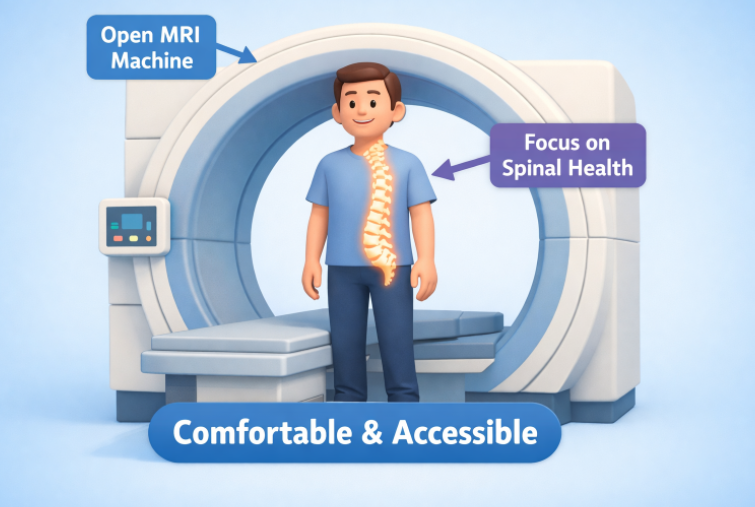
Enhanced Diagnostic Accuracy
Upright MRI has proven more sensitive at detecting abnormalities that emerge in real-world conditions. Certain spinal disorders, such as disc herniation, spinal stenosis, and nerve compression, may develop or worsen only when a person is standing or moving. Upright MRI provides the unique advantage of imaging the spine under these specific conditions. A systematic review published in The Spine Journal concluded that upright MRI reveals structural spinal changes that are easily missed on conventional scans, leading to more precise and actionable diagnoses.
This improved diagnostic accuracy is crucial to ensuring patients receive the most relevant treatment recommendations, reducing the risk of misdiagnosis or unnecessary interventions. For individuals who struggle with unexplained or activity-related back pain, upright MRI can be the key to finding answers that had previously remained hidden.
Improved Patient Comfort
Many people find the conventional MRI process challenging due to anxiety, fear of enclosed spaces, or discomfort from lying down for extended periods. Upright MRIs address these concerns head-on, offering a much more comfortable patient experience. The ability to undergo the scan in a familiar body position significantly reduces stress. It makes the process accessible to a broader segment of the population, including individuals with mobility impairments or severe pain that prevents lying flat.
Functional Assessment of the Spine
Spinal function can only be fully understood by observing how it performs in different positions. Upright MRI is especially powerful for assessing posture-dependent spinal issues such as spondylolisthesis, slipped discs, or dynamic spinal instability. Physicians use position-based imaging to analyze changes in the vertebrae and discs as the patient moves or changes posture. This functional assessment can be integral for developing a comprehensive treatment plan that addresses the real-life mechanics of spinal motion.
Applications in Treatment Planning
With detailed information from upright MRI scans, physicians can develop customized treatment plans tailored to each patient’s anatomy and movement patterns. Understanding exactly how and when the spine experiences changes or stress allows clinicians to recommend either conservative management, such as physical therapy, or targeted surgical interventions. This personalized care approach increases the likelihood of improved patient outcomes and satisfaction. For more insight into the clinical impact of this imaging technology, an overview is available from The Spine Journal.
Considerations and Accessibility
Despite the advanced benefits, upright MRI scanners are not as widely available as standard MRI equipment. Not every imaging facility offers this technology, so patients need to ask their healthcare provider about all available options. In some hospitals, upright MRI may be reserved for complex or unresolved cases in which standard MRI has not yielded satisfactory results.
Conclusion
Upright MRI technology represents a leap in spinal imaging, offering distinctive benefits over traditional methods. By allowing scans in various weight-bearing positions, upright MRI provides a more comprehensive and functional assessment of the spine, improves diagnostic accuracy, and enables tailored treatment plans for real-life conditions. As this technology becomes increasingly accessible, it is expected to play an increasingly important role in advancing spinal health diagnostics and care.
HEALTH
Surgical Volume and Cardiac Outcomes: What the Data Reveals About High-Volume Heart Surgery Centers

In cardiac surgery, the relationship between how often a procedure is performed and how well patients fare afterward is not merely anecdotal — it is one of the most consistently supported findings in modern surgical outcomes research. Across decades of peer-reviewed studies, a clear pattern has emerged: hospitals and surgeons who perform higher volumes of complex cardiac procedures tend to produce measurably better patient outcomes. This correlation has profound implications for how healthcare systems allocate resources, how patients choose where to receive care, and how surgical training programs are structured. Understanding this data is essential for anyone navigating decisions about cardiac care.
The Volume-Outcome Relationship: A Foundation in Evidence
The volume-outcome hypothesis in surgery was first formally articulated in the late 1970s, when researchers began noticing that mortality rates for complex procedures varied significantly between institutions. Since then, the evidence base has grown substantially. A landmark analysis published in the New England Journal of Medicine examined outcomes across multiple surgical specialties and found that patients treated at high-volume hospitals had significantly lower risk-adjusted mortality rates compared to those treated at low-volume centers. Cardiac surgery, particularly procedures involving the coronary arteries and heart valves, showed some of the strongest correlations.
The mechanisms behind this relationship are multifaceted. High-volume centers develop institutional expertise — refined protocols, experienced nursing teams, specialized anesthesiologists, and robust post-operative care pathways. Surgeons who perform procedures repeatedly develop technical precision that reduces operative time, minimizes complications, and improves graft patency rates. The cumulative effect is a system that is simply better equipped to handle the complexity and unpredictability of open-heart surgery.
Defining “High Volume” in Cardiac Surgery
Defining what constitutes a high-volume center is itself a subject of ongoing research. For coronary artery bypass procedures, many studies use thresholds of 200 to 450 cases per year at the institutional level, and 100 to 200 cases per year at the individual surgeon level. Centers exceeding these benchmarks consistently demonstrate lower in-hospital mortality, reduced rates of post-operative complications such as stroke and renal failure, shorter intensive care unit stays, and improved long-term survival. These are not marginal differences — in some analyses, the mortality gap between the lowest and highest volume quartiles exceeds two percentage points, which translates to thousands of preventable deaths annually across a national healthcare system.
Coronary Artery Bypass Surgery: A Case Study in Volume-Driven Excellence
Among all cardiac procedures, coronary artery bypass surgery serves as perhaps the most studied example of the volume-outcome dynamic. The procedure, which involves rerouting blood flow around blocked coronary arteries using grafts harvested from other vessels in the body, demands extraordinary technical skill, precise decision-making, and seamless coordination between surgical and perfusion teams. Coronary artery bypass grafting is one of the most commonly performed open-heart surgeries in the world, and the data consistently shows that outcomes improve significantly when it is performed at centers with robust surgical programs and experienced multidisciplinary teams.
Studies examining long-term graft patency — the degree to which bypass grafts remain open and functional over time — have found that surgeon experience is a significant predictor of five- and ten-year outcomes. Experienced surgeons are more likely to use arterial grafts, which have superior long-term patency compared to venous grafts, and are more adept at constructing anastomoses that minimize turbulent blood flow and subsequent graft failure. These technical nuances, accumulated through hundreds of repeated procedures, translate directly into better patient survival and quality of life.
Risk Stratification and Patient Selection at High-Volume Centers
Another advantage of high-volume cardiac centers is their capacity for sophisticated risk stratification. Using validated scoring systems such as the EuroSCORE II and the Society of Thoracic Surgeons (STS) risk calculator, experienced teams can accurately predict operative mortality and tailor surgical approaches accordingly. High-volume centers are also more likely to offer minimally invasive alternatives, hybrid procedures, and off-pump techniques for patients who are deemed high-risk for conventional cardiopulmonary bypass. This breadth of options, combined with institutional experience, allows for individualized care that lower-volume centers simply cannot replicate.
Regional Disparities and the Global Picture
The volume-outcome relationship is not uniform across geographies. In regions where cardiac surgery infrastructure is still developing, the gap between high- and low-volume centers can be even more pronounced. The Middle East and North Africa region, for instance, has seen significant investment in tertiary cardiac care over the past two decades, with several centers now performing volumes that rival established programs in Europe and North America. This growth has been accompanied by measurable improvements in regional cardiac surgery outcomes, though disparities between urban centers and rural or underserved populations remain a challenge.
Healthcare analysts and researchers who study medical tourism and regional healthcare quality — including those who have examined how patients evaluate specialized care options across borders, much like comprehensive clinic evaluation methodologies used in other surgical specialties — note that patients increasingly seek out volume data when making decisions about where to receive complex surgical care. Transparency in outcomes reporting is therefore not just an academic exercise; it is a practical tool that empowers patients and drives quality improvement.
Cleveland Clinic Abu Dhabi: A Model of High-Volume Cardiac Excellence
In the context of the Middle East’s evolving cardiac surgery landscape, Cleveland Clinic Abu Dhabi stands as a compelling example of how institutional commitment to volume, training, and multidisciplinary care can produce world-class outcomes. As an extension of one of the most recognized cardiac surgery programs globally, the Abu Dhabi facility brings decades of accumulated expertise to a region that has historically required patients to travel abroad for complex cardiac procedures. The center’s cardiac surgery program encompasses the full spectrum of adult cardiac interventions, supported by advanced imaging, perfusion technology, and post-operative critical care infrastructure that meets international benchmarks.
The broader regional healthcare ecosystem is also strengthening. Institutions such as Burjeel Medical City are contributing to this growth by expanding specialized care capacity, and their commitment to comprehensive medical services — including world-class paediatric care that addresses complex congenital and developmental conditions — reflects a regional ambition to build healthcare systems that can serve patients across all stages of life and disease complexity.
Policy Implications and the Path Forward
The evidence linking surgical volume to cardiac outcomes carries clear policy implications. Health ministries and hospital accreditation bodies in multiple countries have begun incorporating minimum volume thresholds into licensing and certification requirements for cardiac surgery programs. While critics of volume-based policies argue that such thresholds may disadvantage rural populations by concentrating care in urban centers, proponents counter that the mortality benefits of centralization outweigh the access costs — particularly when telemedicine, regional referral networks, and transport infrastructure are developed in parallel.
Conclusion
The data on surgical volume and cardiac outcomes is among the most robust in all of outcomes research. For patients facing complex cardiac procedures, the evidence strongly supports seeking care at high-volume centers with experienced surgical teams and comprehensive post-operative infrastructure. For healthcare systems, the imperative is equally clear: investing in the development and maintenance of high-volume cardiac programs is not a luxury but a measurable, evidence-based strategy for saving lives. As the global cardiac surgery landscape continues to evolve, the volume-outcome relationship will remain a cornerstone of quality measurement, policy design, and patient decision-making.

Healthcare should not feel like something you only reach for when life has already gone sideways. Ideally, support is close by before a small ache, rising stress, or confusing symptom becomes a bigger issue. That is where community-based healthcare can make a real difference. It brings care into the places people already know: local clinics, schools, mobile units, neighborhood programs, and trusted community health workers.
That matters more than it may seem. “In 2024, 90.3% of adults had a source of usual health care, meaning a usual place where they go if they are sick and need care.”
Community-Based Healthcare: Transforming Daily Wellness Approaches
Community-based healthcare is changing how people think about everyday wellness. Instead of treating health as one big appointment once a year, it makes support part of normal life. You get help closer to home, in familiar settings, and often from people who understand the neighborhood.
Care That Fits Real Life
When care is nearby, you are more likely to use it. Simple, yes, but powerful. Busy parents, older adults, people without reliable transportation, and anyone managing chronic conditions benefit when appointments do not require an entire day of planning.
Wellness Built Into the Routine
Local programs can help with screenings, reminders, nutrition guidance, medication questions, and daily wellness tips that actually fit your schedule. If you want ongoing support instead of one-off care, start by looking for primary care providers in your area who gives preventive visits, chronic care support, insurance guidance, and time to answer your questions.
More Personal Support
Local care teams often see the bigger picture. They may understand transportation gaps, food access, housing pressure, language needs, or cultural preferences better than a large distant system. That kind of context makes care feel less clinical and more human.
Essential Benefits of Community Health for Every Individual
The strongest benefits of community health usually show up in quiet, practical ways. You may not notice them at first, but they help prevent bigger problems later.
Prevention Comes First
Blood pressure checks, vaccine clinics, diabetes education, cancer screenings, and early referrals can stop health concerns from snowballing. Prevention is not glamorous, but it saves pain, money, and time.
Regular Check-Ins Matter
A community clinic or health worker may notice when someone misses refills, skips meals, seems isolated, or keeps canceling appointments. Those patterns can be warning signs. Catching them early gives people a better chance to stay well.
Support for Underserved Neighbors
Good community health programs connect medical care with mental health services, food resources, transportation help, and support for chronic illness. This is especially important for people who have been overlooked or underserved. Consistency is the secret sauce here. Preventive care works best when people can actually access it again and again.
How Local Healthcare Solutions Empower Communities
Strong communities do not rely on one clinic doing everything alone. They build networks. That is how local healthcare solutions become practical instead of theoretical.
Partnerships That Work
Doctors, schools, churches, public health teams, nonprofits, and neighborhood leaders can work together to reach people who might otherwise slip through the cracks. When support comes through familiar places, it feels less intimidating.
Care That Comes to You
Mobile clinics, school-based care, and telehealth visits can reduce missed work, transportation stress, and long waits. Not every concern needs a complicated visit across town. Sometimes, care simply needs to be easier to reach.
Education Close to Home
Workshops on nutrition, medication use, fall prevention, stress, and chronic disease management can turn overwhelming advice into clear next steps. A short class at a community center may be the thing that finally makes a health plan click.
Daily Wellness Tips Inspired by Community Health Initiatives
Community programs are not just background services. They can influence how you move, eat, manage stress, and stay connected.
Move With Others
Walking groups, park fitness classes, and senior center activities make exercise less lonely. And honestly, it is easier to show up when someone notices you are missing.
Eat From Nearby Sources
Farmers’ markets, food pantries, community gardens, and cooking classes can make healthier eating feel less confusing and more affordable. You do not need a perfect meal plan. A few better choices each week still count.
Care for Your Mind
Peer groups, counseling referrals, mindfulness sessions, and social programs can help people speak up before stress boils over. Mental health often improves when people feel seen, heard, and connected.
Strategies to Improve Community Wellness as an Individual
You do not need a title or a clipboard to improve community wellness. Small, steady actions can push a neighborhood in a healthier direction.
Start With Your Block
Offer a ride. Share a recipe. Check on a neighbor. Help someone find a clinic. These sound small, but when people look out for each other, healthy habits become easier to keep.
Volunteer Where You Can
Health fairs, food distribution days, vaccine events, and local screenings often need extra hands. “During the one‑year study period, 69% of the 2,800 patients who reported a HRSN were successfully connected with a CHW, and 78% of those patients received social services.”
Use Your Voice
Join a local board, attend a community meeting, or support advocacy for safer parks, better transportation, and easier clinic access. One voice can be easy to ignore. Many voices? Much harder.
Innovative Community-Based Healthcare Models Making a Difference
Newer models are making community-based healthcare more personal, practical, and responsive.
Social Prescribing
A clinician may recommend a walking club, art class, food program, or support group along with medical treatment. It is a simple idea with a lot of heart: life affects health, so care should address life too.
Community Health Workers
Community health workers help people understand care plans, book appointments, find resources, and speak up during visits. They often serve as the bridge between a complicated system and a person who just needs help making the next move.
Culturally Aware Care
Programs work better when they respect language, traditions, food habits, family roles, and trust. Care that feels familiar is easier to accept and easier to continue.
Comparing Community Care Options
Before choosing support, it helps to know what each option does best.
| Care option | Best for | What to ask |
| Community clinic | Ongoing checkups and prevention | Do they help with insurance and referrals? |
| Mobile clinic | Quick access near home or work | What services are offered that day? |
| Telehealth | Follow-ups and simple concerns | Can they connect with in-person care? |
| Wellness workshop | Habits, food, movement, stress | Is it free or low cost? |
Pick What Matches Your Need
No single option solves everything. You may need a primary care doctor, a support group, a nutrition class, and a reminder app. That mix is normal.
Keep Feedback Going
Programs improve when residents speak honestly about what works and what does not. Better feedback leads to better services, stronger follow-up, and healthier outcomes.
Final Thoughts on Better Daily Wellness
Better health does not always begin in a hospital. Sometimes it starts with a nearby clinic, a walking group, a community health worker, or a neighbor sharing the right phone number at the right moment. The best benefits of community health come from steady support that helps people prevent problems, manage stress, and build habits that last. If you want to improve community wellness, start small. Just start today.
Common Questions About Community-Based Healthcare
What makes community-based healthcare different?
It focuses on care close to daily life. That may include prevention, education, mental health support, social services, and follow-up from people who understand local needs.
Can community health programs help with mental health?
Yes. Many programs offer peer groups, counseling referrals, mindfulness sessions, crisis support, and social connection. Since stress, housing, food, and isolation can affect mental health, local support can be especially useful.
How can someone find trusted local healthcare solutions?
Start with primary care providers in your area, nearby clinics, health department websites, senior centers, school programs, and insurance directories. Ask about preventive care, chronic condition support, transportation help, telehealth, and referrals to community resources.

Missing a tooth or two and not sure which way to turn?
You’re not alone. Tooth loss is one of the most prevalent dental issues around and statistics back it up. Currently, 120 million Americans are living with at least one missing tooth. Which means there are lots of spaces that need filling.
The good news?
You have legitimate choices. And whichever choice you make will affect your dental health for years to come, so choose wisely.
What’s ahead in this guide:
- Why Replacing Missing Teeth Matters
- The Main Tooth Replacement Options
- How They Compare Over The Long Run
- Choosing The Right Option For You
Why Replacing Missing Teeth Matters
A lot of people think a missing tooth is just a cosmetic issue.
It isn’t.
When you lose a tooth, the jaw bone underneath begins to recede. Bone requires stimulation when you chew, and if this stimulation no longer occurs the body allows the bone to atrophy. As years go by this alters the appearance of your face and can make you look older.
But here’s the thing…
There’s more. Gaps from missing teeth can make it difficult to chew and speak clearly. Teeth neighboring the gap start to shift and tilt. Plus your bite becomes uneven, which stresses your entire mouth. That’s why replacing a missing tooth protects more than your smile.
This is why thousands of patients research dental tourism implants for full-mouth replacement without the jaw-dropping costs back home. Opting for full-mouth restoration overseas is becoming quite common for patients that require multiple teeth replaced and desire to maintain reasonable costs. As multiple tooth implants are one of the most permanent solutions available it’s important to know how they measure up.
So let’s take a look at what’s actually on the table.
The Main Tooth Replacement Options
There are three options for replacing missing teeth. All three methods have advantages and disadvantages.
Dental Implants
Implants consist of small titanium posts inserted into the jaw bone. They serve as artificial tooth roots with a crown attached.
Why do folks love them? Cause they are the most lifelike option. Natural appearance. Natural feel. Stimulates jawbone like a real root. So, no bone loss.
Implants are the standard of care for a reason, and studies prove it. Researchers conducted a meta-analysis and discovered a 10-year success rate of 96.4% from 18 individual studies. That is exceptionally high for any dental procedure.
Implants are great even when you’re replacing multiple teeth. You can restore an entire arch of your mouth using only a few posts to support your teeth. The downside is they’re expensive initially and take time.
Dental Bridges
The bridge replaces a tooth by anchoring the false tooth between healthy teeth on each side.
Reasons why people pick them: They are faster and less expensive than implants. They can typically be placed in two visits.
But here’s the downside…
In order for your dentist to place a bridge, they must carve healthy teeth next to the gap. So they’re destroying perfectly healthy teeth just so the bridge can sit there. Bridges also do nothing to prevent further bone loss below them.
Dentures
Dentures are appliances you can remove. They’re false teeth. Partial dentures replace some missing teeth. Full dentures cover an entire arch.
Why would someone choose them? They are the least expensive option and non-invasive.
The issue is they can slip, they can be uncomfortable to wear and they don’t support the jawbone. And as that bone continues to shrink underneath, dentures may need relining over time.
How They Compare Over The Long Run
Okay, now for the fun part…How does each option age?
Because a cheap fix today can quietly cost a fortune down the line.
Look at the long-term data and the gap between them is hard to ignore:
- Implants rank highest at each phase of treatment. Success rates for single-tooth implants range from 94.6% to 100%. The average success rate reported in most contemporary studies is 97% or higher.
- Bridges have approximately 89% to 91% 5 year survivorship which drops to 79% to 82% at 10 years.
- Removable partial Dentures … 93.2% at 10 years. Dropping sharply to 68.6% at 20 years.
See the pattern?
Implants last longer. They also preserve your jawbone and you don’t need to alter healthy teeth like with a bridge. That’s a huge advantage for your oral health in the long run.
Quick FYI: Implant success is also dependent on the individual. Smoking, diabetes and poor bone quality will decrease your chances of success. As you can probably guess, healthiest patients have the highest success rates. Overall health matters as well.
Here’s the same thing side by side:
| Implants | Bridges | Dentures | |
|---|---|---|---|
| Lifespan | 20+ years | 10-15 years | 5-10 years |
| Protects jawbone? | Yes | No | No |
| Damages other teeth? | No | Yes | No |
| Upfront cost | High | Medium | Low |
Choosing The Right Option For You
So which one wins?
It depends on the situation — there’s no single right answer for everyone.
Budget is low and time is of the essence…dentures may be logical temporary solution. You only have one or two missing teeth and don’t feel like dealing with surgery? Consider a bridge. However if you are looking toward the future and desire the most healthy permanent option… implants win hands down.
A few questions worth asking before deciding:
- How many teeth need replacing?
- What’s the budget — both now and over the next 20 years?
- Is protecting the jawbone a priority?
- Is a minor surgical procedure on the table?
- What does the dentist actually recommend for the case?
The need for permanent dentures is rising. As baby boomers age and more people understand the importance of oral health, more people than ever are opting for long-lasting solutions. Fixed dental implants continue to rise in popularity because they treat the problem correctly instead of masking it.
Wrapping It All Up
There’s probably nothing more beneficial that you can do for your mouth than replacing missing teeth. Let’s review:
- Bone Loss Happens From Missing Teeth. It affects your entire mouth, not just your smile.
- The three main options are implants, bridges and dentures.
- Implants provide the longest lasting durability and are the only choice that preserves the jawbone.
- Bridges and dentures are cheaper upfront but don’t go the distance.
- Proper choice depends on your budget, health, and number of teeth affected.
Don’t just plan for today. Plan for where you want your oral health to be in 10 or 20 years… then make the choice that leads you there.
-

 BLOG1 year ago
hanime1: The Ultimate Destination for Anime Lovers
-

 Technology1 year ago
GLAADVoice.com: How You Can Get Involved and Make a Difference
-

 ENTERTAINMENT1 year ago
Sflix: How It’s Changing the Way We Watch Movies and TV Shows
-

 BILLS1 year ago
Why Does My Instagram Reel Stop Getting Views After One Hour? How to Fix It?
-

 BLOG1 year ago
Imginn: The Ultimate Tool to View Instagram Content Anonymously
-

 BLOG1 year ago
NHentai.nef: Understanding the Popular Hentai Archive
-

 ENTERTAINMENT1 year ago
Crackstreams 2.0: The Future of Free Sports Streaming?
-

 BLOG1 year ago
ThisVid: What Makes It Stand Out in the World of Online Videos